AI and Yoga: The Miracle 5 Steps to Master Your Mind-Body Connection.
Yoga, a tradition spanning millennia, has consistently served as a cornerstone of our quest for inner peace and physical well-being. Yet, we live in the era of data, speed, and technology. When these two disparate worlds—ancient stillness and digital acceleration—intersect, the resulting synergy is fundamentally transforming the practice of yoga. At the heart of this revolution lies the potent combination of AI and Yoga (AIY), driven by the power of personalization.
This comprehensive article does more than just detail a technological integration; it meticulously explores the scientific depth, practical reliability, and accessibility potential that AI brings to the philosophy of yoga. Let’s delve into the powerful and miraculous steps we can take to achieve peak mind-body harmony, guided by the precision of the digital age.
Table of Contents
The AI and Yoga Nexus: The Philosophy of Digitalized Practice
AI and Yoga Applications: How AI Transforms Your Practice
Precise Posture (Asana) Correction via Computer Vision
Deep Learning and Biomechanical Analysis
Personalized Flows and Programs: Adaptive Learning
Optimization Using Data from Wearable Technology
Breath (Pranayama) and Meditation Analysis: Biometric Feedback
3 Critical Ethical Considerations in AI and Yoga Practice
Data Security and Privacy Sensitivity
Human Teacher vs. AI Algorithm: The Value of Experience
Technological Accessibility and Equity
The Future Yoga Studio: AI and Yoga in VR and AR Environments
The Miracle 5 Steps: A Beginner’s Guide to AI-Supported Yoga Practice
1. The AI and Yoga Nexus: The Philosophy of Digitalized Practice
The philosophical foundation of yoga rests on the principle of sthiram sukam asanam: a posture (asana) should be both steady (sthira) and comfortable (sukha). AI contributes to this by underpinning both principles with scientific data.
Traditionally, “steadiness” relied on the teacher’s observation, and “comfort” on the student’s bodily awareness. AI and Yoga objectify this process. AI analyzes the load distribution, joint stress, and muscle activation across the body, helping the individual find the most effective and safest position. Consequently, an asana is not just performed correctly visually, but is also optimally aligned biomechanically.
The main goal of this merger is not to lose the soul of yoga to technology, but rather to integrate it into modern human lifestyles, making it more accessible and highly personalized. For a deeper understanding of yoga’s core principles, you may refer to https://alwordpulse.com/gemini-ai-google-generative-ai-2025/
2. AI and Yoga Applications: How AI Transforms Your Practice
The synergy between AI and Yoga is creating a revolution across three primary areas of the practice:
Precise Posture (Asana) Correction via Computer Vision
Alignment is a key safety element in yoga. AI offers a level of accuracy that surpasses the human eye.
Deep Learning and Biomechanical Analysis
AI-supported applications typically leverage Deep Learning algorithms and Computer Vision technology:
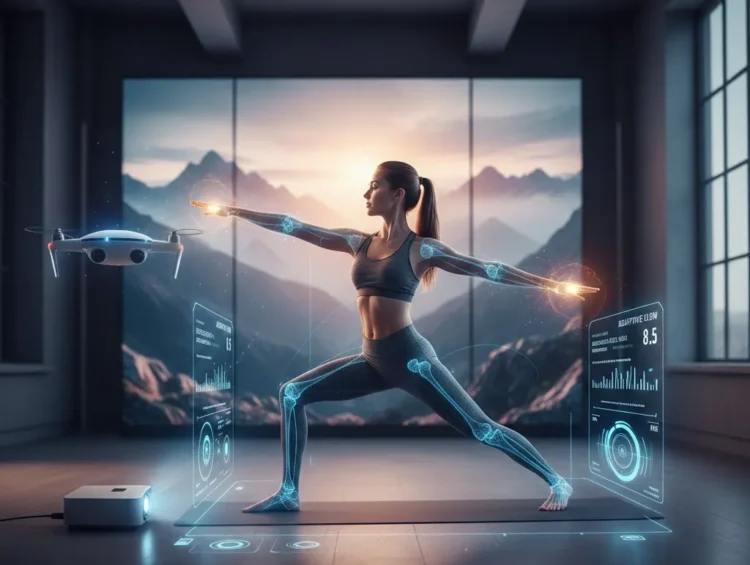
Skeleton Tracking: The AI analyzes the image captured by your device’s camera hundreds of times per second, mapping over 30 key joint points (hips, knees, ankles, shoulders, etc.) on your body.
Angular Comparison: These maps are compared against thousands of pre-loaded expert yoga posture data points. The AI maintains a mathematical reference; for instance, in Triangle Pose (Trikonasana), the angle of the front leg should be close to $180° – \theta$ (where $\theta$ is the torso angle).
Instantaneous Voice Feedback: When the AI detects a deviation from the reference value, it provides immediate and specific commands, such as “Slightly tuck your right hip back,” or “Soften your knee cap.”
These micro-level adjustments make AI and Yoga practice incredibly safe and effective, especially for beginners.
Personalized Flows and Programs: Adaptive Learning
A traditional yoga class requires all participants to follow the same flow. Yet, the needs of an athlete differ greatly from someone with chronic back pain. AI and Yoga eliminate this one-size-fits-all approach.
Optimization Using Data from Wearable Technology
The AI continuously processes biometric data streamed from wearable devices:
Heart Rate Variability (HRV): High HRV indicates an active parasympathetic system (i.e., you are relaxed). When HRV is low, the AI adjusts the practice towards a more restorative or meditation-focused flow.
Muscle Fatigue Prediction: If data from yesterday’s workout suggests a muscle group is fatigued, the AI will dynamically remove or reduce the intensity of asanas that strain that area in today’s program.
Injury History Integration: Data points, such as a past knee injury, ensure the AI modifies or entirely skips poses that place undue pressure on the affected joints.
This powerful adaptive programming transforms yoga practice into not just fitness, but a sophisticated tool for holistic recovery.
Breath (Pranayama) and Meditation Analysis: Biometric Feedback
The core pillars of yoga—breath and meditation—are also made measurable and improvable through AI and Yoga.
The AI measures the frequency and amplitude of the breath rhythm via microphones or specialized sensors. For example, if you are breathing at a frequency of $f_{breath}$ cycles per minute, the AI determines the deviation from the ideal target of 6 breaths per minute ($0.1 Hz$). Using this data, the AI provides audio or vibrational feedback to guide you in slowing your breath.
3. 3 Critical Ethical Considerations in AI and Yoga Practice
Technological progress always brings ethical responsibilities. In the realm of AI and Yoga, three key ethical areas demand attention:
Data Security and Privacy Sensitivity
AI collects highly sensitive information: from your posture geometry to your heart rate and even mood data. Users must ensure that the applications they use handle data responsibly, ensuring it is anonymized and not shared with third parties. Health data (often protected by regulations like HIPAA and GDPR) requires the highest level of security.
Human Teacher vs. AI Algorithm: The Value of Experience
An AI can never fully replace a guru or an experienced teacher. Yoga is not just a technical exercise; it is an experience of energy (prana) and community (sangha). The encouragement from a teacher, a slight adjustment via touch, or the shared energy of a class cannot be replicated by algorithms. The role of AI is to support the human teacher, allowing them to focus their time on issues requiring personal attention and emotional intelligence.
Technological Accessibility and Equity
The most advanced AI and Yoga solutions often require expensive subscriptions or proprietary hardware (smart mats, EEG devices). This poses the risk of a digital divide, where individuals with limited income or technological access are excluded from these powerful tools. The industry must focus on developing affordable and widely accessible solutions.
4. The Future Yoga Studio: AI and Yoga in VR and AR Environments
The future extends beyond our yoga mats:
Holographic Instructors: Augmented Reality (AR) glasses will allow an AI-driven virtual instructor to materialize in your living room and perform poses alongside you. This instructor will provide real-time, highly personalized corrections.
Virtual Environments (VR): Virtual Reality (VR) headsets will transport users to a serene beach or the peak of the Himalayas, deepening the meditation experience through immersive environmental stimuli. The AI will customize this environment based on the user’s current stress level (e.g., presenting a less stimulating environment if stress is detected).
Through AI and Yoga, these technologies promise a miraculous and truly inclusive practice experience.
5. The Miracle 5 Steps: A Beginner’s Guide to AI-Supported Yoga Practice
If you are ready to elevate your practice and achieve deeper mind-body harmony with AI and Yoga, here are 5 simple, powerful steps to guide your journey:
Select the Right Application and Use Your Focus Keyword: Find a trustworthy application that uses Computer Vision and AI and Yoga alignment feedback, backed by good user reviews.
Enable Biometric Data Sharing: Pair the app with your smartwatch or fitness tracker. Share data on sleep, heart rate, and activity to allow the AI to build programs tailored specifically to you.
Input Specific Goals: Don’t just tell the AI you want to do yoga. Input concrete, measurable goals like “Reduce lower back pain” or “Improve shoulder mobility.”
Trust the Data, But Listen to Your Intuition: Pay attention to the AI’s corrections, but always listen to what your body feels. In your AI and Yoga practice, the AI is a tool, but your inner voice should remain your ultimate guide.
Maintain Real Human Connection: Supplement your digital practice with a face-to-face session with an experienced human teacher once or twice a month. This is essential for verifying your technique and benefiting from community energy.
Achieving mind-body harmony through AI and Yoga is no longer science fiction—it is at your fingertips. Embrace this exciting and transformative shift.
The Top 10 AI Companies Making a Global Impact: The Groundbreaking Leaders of the Future
scientific findings on AI-driven biomechanical analysis in exercise