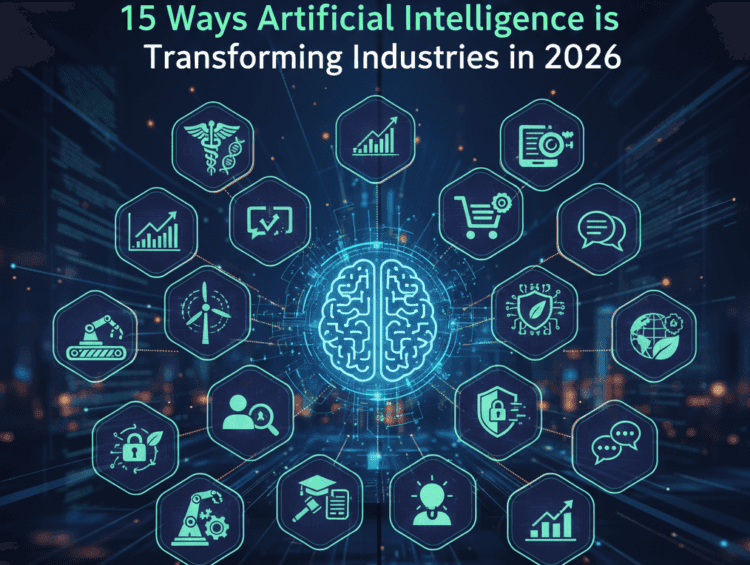
The Ultimate Guide to AI Applications: 15 Ways Artificial Intelligence is Transforming Industries in 2026
The year 2026 marks a pivotal shift in the technological landscape: the transition of Artificial Intelligence (AI) from a speculative promise to an indispensable, core operational tool. We are no longer debating if AI will change the world, but how deeply and how quickly it will redefine human work, commerce, and creativity.
This isn’t just about chatbots. The real revolution is happening in the specialized Artificial Intelligence Applications that are quietly embedding themselves into the engines of global industries—from generating life-saving drugs to autonomously managing power grids.
This comprehensive guide will break down the fifteen most impactful and disruptive Artificial Intelligence Applications shaping the global economy in 2026. By the end of this analysis, you will gain the knowledge and insight needed to navigate this new era and identify areas where your business or career can harness these monumental forces.
Part 1: Reshaping the Core Industries (Healthcare, Finance, and Manufacturing)
The sectors where precision, data volume, and speed are paramount have been the first to embrace sophisticated Artificial Intelligence Applications.
1. Precision Medicine and Drug Discovery
The Application: AI models are drastically accelerating the identification of viable drug candidates, reducing the time required for pre-clinical trials from years to months. Machine learning algorithms analyze billions of data points—genomic sequences, protein structures, and patient health records—to predict drug efficacy and toxicity with unprecedented accuracy. Key Impact: This application is fundamentally changing the pharmaceutical R&D pipeline, making personalized treatment based on an individual’s genetic makeup a reality. Knowledge Gained: Understanding the regulatory pathways for AI-discovered drugs is now critical for investment and compliance teams in HealthTech.
2. Algorithmic Trading and Risk Management
The Application: Financial institutions use complex Artificial Intelligence Applications to execute high-frequency trades, identify arbitrage opportunities, and manage massive portfolios. Crucially, AI is now the primary tool for real-time risk assessment, detecting fraudulent transactions and money laundering patterns that are too subtle for human analysts to spot. Key Impact: AI provides a significant speed advantage in volatile markets and fortifies the security perimeter of the global financial system. Knowledge Gained: FinTech professionals must learn to audit and govern autonomous trading agents to maintain market integrity and ethical standards.
3. Predictive Maintenance in Manufacturing
The Application: Industrial IoT sensors installed in factory floors, energy grids, and logistics vehicles feed continuous data to machine learning models. These Artificial Intelligence Applications predict equipment failure probabilities long before they occur, allowing maintenance to be scheduled proactively, not reactively. Key Impact: Reduces downtime by 20-50%, extends the lifespan of expensive machinery, and optimizes supply chain logistics, translating directly into billions in savings for the automotive and energy sectors. Knowledge Gained: Engineers should be skilled in integrating edge computing devices with cloud-based AI platforms for scalable predictive maintenance solutions.
Part 2: Enhancing the User Experience (Communication, Content, and Commerce)
These Artificial Intelligence Applications focus on augmenting human interaction and personalizing the digital world, touching nearly every consumer globally.
4. Hyper-Personalized Retail and Recommendation Engines
The Application: Beyond simple collaborative filtering, modern Artificial Intelligence Applications analyze behavioral data, social sentiment, and even visual cues from user images to create truly personalized shopping experiences, dynamic pricing, and tailored product recommendations. Key Impact: Drives higher conversion rates for e-commerce platforms and reduces inventory waste by more accurately forecasting demand. Knowledge Gained: Marketing professionals must master A/B testing methods tailored for AI-driven campaigns, where personalization is fluid and constantly evolving.
5. Advanced Natural Language Processing (NLP) for Customer Service
The Application: The evolution of large language models (LLMs) has led to sophisticated AI chatbots and virtual agents that handle 80% of routine customer inquiries without human intervention. The best Artificial Intelligence Applications in this space understand nuanced human emotion and context switching. Key Impact: Drastically cuts call center operational costs while improving customer satisfaction through 24/7 instant response capabilities. Knowledge Gained: Businesses should prioritize training their AI chatbots on proprietary knowledge bases to maintain brand voice and ensure factual accuracy, distinguishing them from general-purpose models.
6. Generative Content Creation (Text, Image, and Code)
The Application: Generative Artificial Intelligence Applications create synthetic content—from marketing copy and video scripts to unique digital art and functional code snippets (as seen in AI coding assistants). Key Impact: Accelerates content production workflows across media, education, and software development, lowering the barrier to entry for creative professionals and coders. Knowledge Gained: Creators and businesses must develop robust systems for managing AI-generated intellectual property (IP) and ensuring content authenticity and ethical sourcing.
Part 3: Infrastructure and Global Security (Energy, Defense, and Climate)
These applications leverage AI’s power to manage large, complex systems where failure carries catastrophic consequences.
7. Smart Grid Optimization and Energy Management
The Application: AI algorithms manage power distribution networks in real-time, predicting fluctuating energy demand (based on weather, time of day, and social events) and optimizing the integration of intermittent renewable sources like solar and wind power. Key Impact: Increases energy efficiency, reduces waste, and stabilizes grids that rely heavily on decentralized renewable energy inputs. Knowledge Gained: Urban planners and utility companies need expertise in developing secure, decentralized network architectures capable of handling AI-driven load balancing.
8. Cyber Threat Detection and Response
The Application: Traditional signature-based security is obsolete. Modern Artificial Intelligence Applications use deep learning to detect anomalies in network traffic and user behavior, identifying zero-day attacks and rapidly evolving malware in milliseconds. Key Impact: Provides proactive defense against state-sponsored cyber espionage and ransomware attacks, protecting critical national infrastructure and corporate data. Knowledge Gained: Cybersecurity teams must shift their focus from reactive patching to training and validating the integrity of their AI-powered defense systems.
9. Climate Modeling and Prediction
The Application: AI processes massive, multi-modal climate data sets (satellite imagery, sensor readings, historical patterns) to create highly accurate, localized climate forecasts and model the impact of mitigation strategies. Key Impact: Improves disaster preparedness, aids in agricultural planning, and informs policy decisions regarding carbon reduction efforts globally. Knowledge Gained: Data scientists specializing in geospatial modeling are increasingly vital to both governmental and non-governmental climate research institutions.
Part 4: The Future of Work and Innovation (Human Resources, Education, and Robotics)
These Artificial Intelligence Applications are focused on augmenting human capability, not replacing it, by automating repetitive, skill-based tasks.
10. Automated Recruitment and Talent Management
The Application: AI screens resumes, predicts candidate success based on structured data, and automates initial interview scheduling. More advanced Artificial Intelligence Applications analyze employee performance data to suggest personalized career development paths and identify flight risks. Key Impact: Reduces hiring bias (when properly governed) and significantly lowers the time-to-hire for high-volume roles, streamlining HR operations. Knowledge Gained: HR professionals need to be trained on the ethical implications of algorithmic hiring to prevent the perpetuation of existing biases through flawed training data.
11. Personalized Adaptive Learning Systems
The Application: In education, AI tutors and platforms analyze a student’s performance, learning style, and pace to dynamically adjust curriculum delivery and provide real-time, targeted support. Key Impact: Maximizes student engagement and improves educational outcomes by moving away from “one-size-fits-all” instruction, addressing learning gaps early. Knowledge Gained: Educators must collaborate with developers to ensure AI tools support pedagogical goals and do not replace the critical role of human mentorship.
12. Advanced Robotic Automation
The Application: AI is moving robots beyond simple, repetitive tasks (like assembly lines) to complex decision-making in unpredictable environments (warehouses, disaster zones). This includes enhanced computer vision and fine-motor control, driven by reinforcement learning. Key Impact: Enables complete automation of complex logistics and last-mile delivery, increasing throughput and worker safety in dangerous environments. Knowledge Gained: Manufacturing leadership should focus on retraining human workers to manage, program, and maintain these sophisticated AI-driven robotic systems.
Part 5: The Cutting Edge (New Frontiers in AI)
The final three applications represent the most recent advancements poised for mass adoption in the next few years.
13. Algorithmic Legal Discovery and Compliance
The Application: Law firms and large corporations use Artificial Intelligence Applications to rapidly sift through billions of legal documents, emails, and communications to find relevant evidence (e-Discovery) or ensure regulatory compliance. Key Impact: Dramatically reduces the time and cost associated with litigation and internal audits, making complex legal processes more accessible and efficient. Knowledge Gained: Legal professionals need foundational training in prompt engineering and data security protocols to interact effectively with AI-powered legal tools.
14. Real-Time Language Translation and Interpretation
The Application: Advances in sequence-to-sequence models allow for near-instantaneous and highly context-aware translation of both spoken and written language, eliminating communication barriers in global commerce and diplomacy. Key Impact: Facilitates smoother international business expansion and enhances communication in multilingual collaboration environments. Knowledge Gained: Businesses should integrate real-time translation tools into their internal communication platforms to support diverse, decentralized global teams.
15. Financial Forecasting for Small to Medium Enterprises (SMEs)
The Application: Previously reserved for large corporations, cloud-based Artificial Intelligence Applications now offer SMEs accessible tools for accurate sales forecasting, inventory management, and cash flow prediction based on market trends and internal data. Key Impact: Levels the playing field by providing smaller businesses with the analytical power needed to optimize operations and compete with larger rivals. Knowledge Gained: Small business owners must learn to trust and validate AI-driven forecasts against their own deep market knowledge to make the most informed strategic decisions.
Conclusion: Embracing the AI-Augmented Future
The landscape defined by these fifteen Artificial Intelligence Applications is not one of human replacement, but one of radical human augmentation. In 2026, proficiency in leveraging AI tools—whether you are a coder, an executive, an educator, or a doctor—is the new baseline for professional success.
The transformation is comprehensive, touching every industry from the high-stakes world of finance and healthcare to the daily logistics of e-commerce. To remain competitive and relevant, individuals and organizations must move beyond understanding the definition of AI and start mastering its practical applications. The ultimate competitive advantage lies not in having the AI, but in expertly applying it. Your ability to integrate these applications into your workflow will define your success in the augmented economy of the future.
The Rise of AI Coding Assistants: How Machines Are Rewriting the Future of Software Development