AI (Artificial Intelligence) vs. HI (Human Intelligence): Where Do They Make a Difference? (2026 Comprehensive Analysis)
Dive deep into the core differences between AI (Artificial Intelligence) vs. HI (Human Intelligence) with 2026 data. Discover the distinct roles in speed, ethics, creativity, and adaptability. Essential reading for navigating the future of work and life balance.
Introduction: Redefining Intelligence and Drawing Boundaries in 2026
By 2026, Artificial Intelligence (AI) technologies have become a foundational pillar of the global economy and daily life. AI is no longer just a tool but a pervasive force constantly interacting with and transforming Human Intelligence (HI). This inevitable interaction makes the question: AI (Artificial Intelligence) vs. HI (Human Intelligence): Where Do They Make a Difference? more critical than ever. This comprehensive article meticulously analyzes the fundamental points of separation between the two forms of intelligence, examining the scientific, philosophical, and economic consequences of this divide in light of 2026’s current data.
Both AI and HI possess unique strengths and weaknesses. AI’s power is rooted entirely in computation, speed, and scale, while HI’s value stems from emotional depth, creative leaps, and ethical reasoning. Our goal is not to outline a competition between the two, but to show how they form a synergistic “Augmented Intelligence” model. This examination provides a vital roadmap for individuals and organizations aiming to thrive in this new technological era.
I. Speed, Scale, and Repetition: The Domains Where AI is Unmatched
AI decisively surpasses Human Intelligence in processing big data, operational speed, and executing repetitive tasks, marking the first and most obvious distinction in the AI (Artificial Intelligence) vs. HI (Human Intelligence) comparison. AI’s strength derives from its lack of biological constraints.
1. Big Data Analysis and Computational Speed: The AI Velocity Advantage
AI systems can analyze vast amounts of data (measured in Petabytes) in milliseconds—a fraction of the time a human would require—to identify complex patterns and make predictions. This fundamental difference is due to AI’s parallel processing capability, allowing it to execute thousands of operations simultaneously, whereas the human brain primarily focuses on sequential processing.
Practical Application and Relevant AI Tool:
Financial Analysis: High-Frequency Trading (HFT) algorithms (e.g., Proprietary Trading AI Bots) analyze global market data millions of times per second, making decisions far below human reaction time. This provides mathematical efficiency contrasted with human investors’ potential emotional or delayed decisions.
Scientific Discovery: In fields like particle physics (CERN experiments) or astronomical observations, Quantum Machine Learning (QML) models are starting to analyze massive datasets that classical computers struggle with, significantly accelerating the discovery of new phenomena.
AI’s Edge: AI accesses and utilizes processing power without the biological constraints of forgetting, fatigue, or distraction.
2. Flawless Repetition and Tasks Requiring High Precision
Artificial Intelligence (AI) can operate 24/7 continuously within its programmed algorithms, free from emotional fluctuation, fatigue, or subjective factors inherent in humans. This is a critical differentiator in industries where the margin for error is zero.
Domains Where the Difference is Evident:
Manufacturing and Quality Control: In nano-technology and microchip fabrication, AI-supported robotic systems (e.g., Cognex Vision Systems) detect sub-millimeter defects that are imperceptible to the human eye, maintaining perfect consistency.
Administrative Automation: In law and finance, Document Management Systems (DMS) and Robotic Process Automation (RPA) tools quickly scan hundreds of thousands of contracts for legal compliance, virtually eliminating human error.
3. Objective Decision-Making and Freedom from Subjectivity
AI bases its decision-making processes solely on the data provided and the programmed rules. This results in a completely objective approach, uninfluenced by the emotional, psychological, or subjective factors that frequently affect human decisions.
AI’s Objectivity: When evaluating a loan application or conducting an insurance risk analysis, AI feels no personal sympathy or antipathy towards the applicant; it merely calculates the risk score. This ensures fair and consistent decisions.
The Ethical Caveat: A crucial ethical dilemma exists here: AI’s objectivity is entirely dependent on the quality of its training data. If the dataset is historically biased, the AI’s output can perpetuate or amplify discrimination (algorithmic bias). This reinforces the critical need for HI’s ethical oversight in the AI (Artificial Intelligence) vs. HI (Human Intelligence) dynamic.
II. Emotion, Creativity, and Flexibility: The Supremacy of Human Intelligence
Human Intelligence is grounded in biological and neurological processes and possesses core qualities that AI is currently unable to genuinely replicate. These areas will continue to hold the highest value in the post-2026 workforce.
1. Radical Creativity, Innovation, and Abstract Thought
Human creativity is nourished by imagination, abstract thought, and emotional depth. Humans can combine previously unrelated concepts, generating completely new ideas and solutions (radical innovation) beyond the patterns they have encountered.
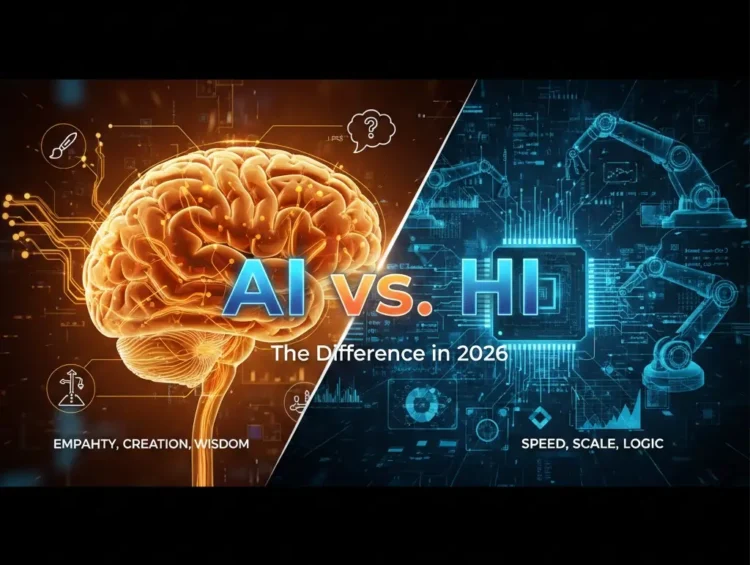
Visual Alt Text: Detailed 2026 analysis of AI (Artificial Intelligence) vs. HI (Human Intelligence) showing the fundamental differences in speed, creativity, and ethical judgment.
AI’s Limitations: While Generative AI (e.g., Midjourney v9 or Google Imagen 3) can produce aesthetically stunning creative output, this output is essentially a statistical combination of billions of patterns in its training data—it is a synthesis, not invention. AI lacks intentionality, conscious context, or genuine personal experience.
HI’s Unique Contribution: Humans can introduce elements like irony, sarcasm, or profound personal suffering into an artwork or philosophical concept. HI has the capacity to break or ignore existing rules, allowing for artistic and scientific paradigm shifts, a capacity still limited in AI.
2. Emotional Intelligence (EQ), Empathy, and Moral Reasoning
This is the fundamental biological and psychological bedrock that makes HI unique in the AI (Artificial Intelligence) vs. HI (Human Intelligence) comparison. The ability to empathize, understand social cues, manage complex human relationships, and engage in true ethical reasoning belongs exclusively to HI.
Areas of Application:
Healthcare and Therapy: While AI (e.g., Affective Computing) can analyze a patient’s emotional state, the act of comforting, building trust, or showing personalized compassion is purely human.
Law and Diplomacy: In complex legal disputes or international diplomacy, emotional intelligence is far more effective than AI’s cold logic in understanding the underlying motivations of parties and finding common ground.
The Consciousness Divide: AI lacks consciousness or qualia (the subjective quality of experience). AI can only operate within the ethical rules it is programmed with; it cannot develop a sense of genuine conscience or moral responsibility.
3. Contextual Understanding, Common Sense, and Adaptability (Transfer Learning)
Human Intelligence excels at rapidly adapting to new conditions and learning from limited examples. HI can masterfully apply knowledge learned in one domain to a completely new, dissimilar context (transfer learning).
HI’s Superiority: Common Sense: Humans can infer the cause and effect of an event without witnessing all the data. For instance, knowing that a glass dropped on the floor will break requires very little explicit training. AI models continue to struggle to acquire this level of common sense contextual knowledge.
AI’s Limitation: AI models (especially traditional ML) are often narrowly specialized for the tasks they were trained on. When “data drift” occurs—where the operating environment deviates from the training data—AI performance can rapidly degrade. HI, by contrast, is flexible and adaptable to ambiguity and complex external world interactions.
Relevant Link: [Internal Link: Human Decision-Making in Crisis Management]
III. Summary of Key Differences and 2026 Synergy: The Augmented Intelligence Era
The comparison between AI (Artificial Intelligence) vs. HI (Human Intelligence) is not a contest for supremacy, but a mandate for synergy in 2026. Success is defined by the “Augmented Intelligence” model, which strategically combines the strengths of both forms of intelligence.
A. Detailed Comparative Summary Table
| Feature | Artificial Intelligence (AI) | Human Intelligence (HI) |
| Learning Origin | Data-Driven, Algorithmic, Quantitative Probabilities | Experience, Observation, Qualitative Insight |
| Speed & Scale | High-Speed Parallel Processing (Petabytes) | Limited Capacity, Sequential Processing (Biological Limits) |
| Memory | Perfect, Instant Recall (Hard Drive/Cloud) | Selective, Subjective, Prone to Error (Neural Networks) |
| Creativity | Pattern-Based Synthesis, Imitation (Synthetic) | Genuine Innovation, Abstract Thought (Original) |
| Decision-Making | Fully Objective, Data and Rule-Based | Subjective, Influenced by Emotion, Ethics, and Conscience |
| Adaptability | Task-Specific, Sensitive to Data Drift | Rapid Adaptation, Transfer Learning to Novel Situations |
| Consciousness & Emotion | Absent (Simulation Only) | Present (Self-Awareness, Empathy, Conscience, Qualia) |
| Energy Consumption | High (During Training and Operation) | Low (Approximately 20 Watts) |
B. Future Vision: HI as Guide, AI as Implementer
The future is predicated on augmentation, where AI serves as an extension of Human Intelligence. The computational power and speed of AI, combined with the intuition, creativity, and emotional depth of HI, is opening the door to a new era for humanity.
Division of Labor: AI can assist doctors by providing complex diagnostic models, help engineers by running thousands of simulations, and aid analysts by calculating risk scores. The human then takes these AI outputs, applies ethical governance, interprets the results within a human context, and translates them into creative solutions.
Philosophical Conclusion: While AI provides the answers to ‘how’ and ‘how fast’, Human Intelligence will continue to provide the answers to ‘why’ and ‘what should be’ (i.e., moral and ethical purpose).