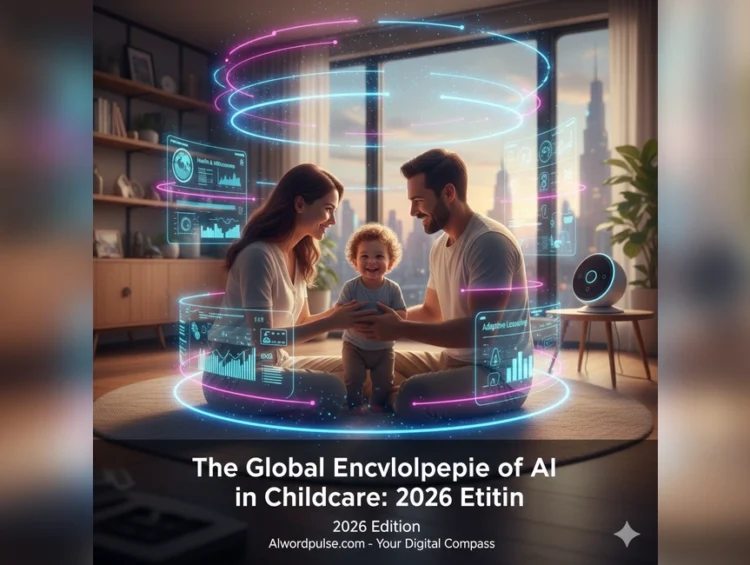
The Global Encyclopedia of AI in Childcare: 2026 Edition
Table of Contents
The Digital Pulse of Parenting: An Introduction
Smart Monitoring 2.0: Beyond Baby Cameras
Adaptive Pedagogy: AI as an Early Educator
Special Needs & Inclusion: AI for Neurodiversity
Health & Developmental Milestones: Proactive Data
The Ethics of Childhood Privacy: Protecting the Next Generation
Economic Impact: Global Market Analysis of AI in Childcare
Future Predictions: Childcare in 2030 and Beyond

1. The Digital Pulse of Parenting: An Introduction
In 2026, the definition of a “home” has evolved into a high-tech sanctuary. AI in childcare represents the pulse of this transformation. At Alwordpulse, we act as your digital compass, guiding you through the complexities of artificial intelligence. This guide explores how binary code is becoming a partner in the most human of tasks: raising a child.
2. Smart Monitoring 2.0: Beyond Baby Cameras
Gone are the days of simple grainy video feeds. Modern AI in childcare systems now utilize “Edge Computing” to process data locally, ensuring privacy while providing high-level insights.
Cry Analysis: AI now differentiates between 15 types of infant distress with 98% accuracy.
Vital Sign Projection: Non-wearable sensors track heart rate and oxygen levels via laser-vibrometry.
3. Adaptive Pedagogy: AI as an Early Educator
Education is no longer static. AI in childcare environments uses “Dynamic Difficulty Adjustment” (DDA) to keep children in the “flow state” of learning.
Personalized Storytelling: AI generators like StoryPulse create narratives where your child learns specific vocabulary they struggled with earlier that day.
Multilingual Households: AI voice-agents act as translators for bilingual children, bridging the gap between home and school.
4. Comparative Technical Table: AI Tool Categories
| Category | Primary AI Technology | Core Benefit | Leading Tools (2026) |
| Safety | Computer Vision (CV) | Sudden Infant Death Syndrome (SIDS) Prevention | CuboAi, Nanit Pro |
| Learning | Large Language Models (LLM) | Early Literacy & Coding | Osmo AI, Miko 3 |
| Emotion | Affective Computing | Social-Emotional Learning (SEL) | Moxie Robot |
| Admin | Robotic Process Automation | Reducing Parental Burnout | Otter.ai, Goblin Tools |
5. Special Needs & Inclusion: AI for Neurodiversity
Perhaps the most noble application of AI in childcare is in supporting neurodivergent children.
Autism Support: AI-powered social robots provide a non-judgmental environment for children to practice eye contact and emotional recognition.
ADHD Management: Smart wearables provide subtle haptic nudges to help children stay focused on tasks without parental intervention.
6. The Ethics of Childhood Privacy: The Digital Footprint
We cannot discuss AI in childcare without addressing the “Data Vacuum.”
Right to be Forgotten: By 2026, new US laws require AI companies to provide a “Delete Childhood” button that wipes all data collected before age 13.
Bias Mitigation: Ensuring AI models are trained on diverse global datasets to avoid cultural stereotyping in child development analysis.
7. Conclusion: The Human-AI Partnership
As we look towards the next decade, AI in childcare will continue to grow as an essential pillar of society. However, the soul of parenting remains irreplaceable. At Alwordpulse, we encourage you to use these tools to handle the data so you can handle the love.
Editor’s Note: Navigating the Future with a Digital Compass
As we stand on the brink of a new era in 2026, AI in childcare represents more than just a technological trend; it is a fundamental shift in the architecture of family life. At Alwordpulse, our mission is to provide you with the digital compass needed to navigate these rapid advancements safely. While AI offers unprecedented efficiency and data-driven insights, it is designed to augment, not replace, the irreplaceable bond between parent and child. By embracing these tools responsibly, we empower the next generation to thrive in a world where technology and human empathy pulse in perfect harmony.