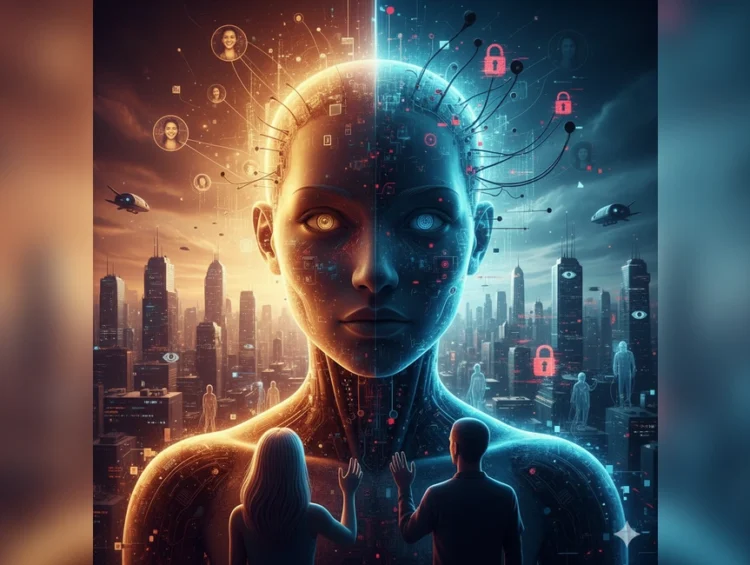
The Dark Side of Artificial Intelligence: 7 Terrifying Risks Awaiting Us
The dark side of artificial intelligence lies in wait just behind the unlimited possibilities offered by technology. The algorithms that make our lives easier today could transform into sophisticated weapons in the hands of cyber attackers or surveillance tools that obliterate our personal privacy tomorrow. As we approach the 2030s, understanding the security and privacy risks brought by this technology is not a choice, but a necessity.
Table of Contents
Introduction: The Shadow of Technological Progress
1. Deepfakes and Mass Disinformation
2. Autonomous Cyber Attacks and Polymorphic Malware
3. The End of Privacy: Algorithmic Surveillance
4. Algorithmic Bias and Social Manipulation
5. Autonomous Weapon Systems and Physical Safety
6. The AI Revolution in Social Engineering
7. Labor Force and Economic Instability Risks
Ethical and Legal Mitigation Strategies
Conclusion: Building a Secure Future
Introduction: The Shadow of Technological Progress
While AI is revolutionizing medicine and science, the dark side of artificial intelligence is becoming more prominent every day. Organizations like the Council of Europe and leading cybersecurity firms warn that AI-powered crimes could increase by 300% over the next decade. In this article, we will examine the security vulnerabilities and privacy breaches that this technological revolution may trigger.
1. Deepfakes and Mass Disinformation
Deepfake technology is one of the first threats that come to mind regarding the dark side of artificial intelligence. A video of a politician saying words they never uttered, or a CEO’s voice being spoofed to authorize a fraudulent wire transfer, is no longer a sci-fi scenario.
Trust Crisis: The inability to distinguish between what is real and what is fake could trigger social chaos by shattering public trust.
Reputation Assassinations: Individuals’ images can be used without consent for blackmail and character assassination operations.
2. Autonomous Cyber Attacks and Polymorphic Malware
In the future, cyber attacks will not be carried out by humans but by self-improving algorithms. The dark side of artificial intelligence can create polymorphic viruses that identify a network’s weak points in seconds and change their shape to bypass firewalls.
These attacks render traditional defense systems ineffective because the attacking software uses machine learning to find a new path every time it is blocked.
3. The End of Privacy: Algorithmic Surveillance
Our personal data is the most valuable fuel for the dark side of artificial intelligence. When cameras, smart devices, and social media data are combined, it becomes possible to predict not just where an individual is, but what their next move will be.
Scoring Systems: Social credit systems being implemented in some regions can restrict fundamental freedoms by keeping citizens under constant AI surveillance.
Invisible Data Harvesting: Algorithms running in the background of apps follow our digital footprints without explicit consent, creating massive profiling pools.
4. Algorithmic Bias and Social Manipulation
Algorithms are not neutral; they carry the biases of the data used to train them. The dark side of artificial intelligence can lead to discrimination against certain groups in hiring, loan applications, and even the justice system.
Furthermore, social media algorithms can trap individuals in “echo chambers,” triggering radicalization and manipulating critical societal events such as election results.
5. Autonomous Weapon Systems and Physical Safety
Autonomous weapon systems, also known as “Killer Robots,” are technologies capable of identifying and engaging targets without human intervention. This could completely eliminate the ethics of warfare.
The dark side of artificial intelligence could turn into a global security crisis if these weapons fall into the hands of terrorist organizations or rogue groups. A software glitch could trigger irreversible military conflicts.
6. The AI Revolution in Social Engineering
Scammers no longer send random emails; instead, they use AI tools that analyze their targets and prepare highly convincing, personalized messages.
The dark side of artificial intelligence can analyze your social media profile to create a bot that speaks in the exact tone of your best friend. These “hyper-personalized” phishing attacks have reached a level that can deceive even those with high digital literacy.
7. Labor Force and Economic Instability Risks
Security is not just about software; economic security must also be evaluated within the scope of the dark side of artificial intelligence. Mass unemployment and increasing income inequality can lead to social unrest and, consequently, physical security problems. Cyber attackers manipulating AI algorithms in financial markets could trigger a global economic collapse.
Ethical and Legal Mitigation Strategies
Urgent steps must be taken globally to minimize these risks:
AI Legislation: Legal frameworks, such as the European Union’s AI Act, are essential to ensure algorithms are transparent and accountable.
AI in Cyber Defense: To counter attackers, defense systems must also be fortified with artificial intelligence (AI vs. AI).
Digital Ethics Education: Individuals must be educated against deepfakes and manipulation techniques.
Conclusion: Building a Secure Future
The dark side of artificial intelligence is an inevitable part of technology, but it is not our destiny. By anticipating future security and privacy issues today, we must embed ethical values into the very lines of software code. To benefit from the light of technology, we must make a collective effort to avoid being lost in its shadow.
AI in 2030: 5 Massive Revolutions That Will Change Our Lives
[…] The Dark Side of Artificial Intelligence: 7 Terrifying Risks Awaiting Us […]