Future AI Jobs: The Ultimate 2030 Career Guide to High-Paying Roles, Salaries, and Strategic Roadmaps
The Gold Rush of the 21st Century: Are You Ready?
Imagine it is 1995. You have a chance to become a “Web Developer” before anyone even knows what a browser is. Most people are skeptical, but the ones who take the leap end up defining the digital age—and becoming the wealthiest leaders of the next three decades.
Today, history is repeating itself, but at 10x the speed.
We are currently standing at the edge of a massive “Cognitive Shift.” The question isn’t whether AI will take your job—it’s whether you will be the one managing the AI that does. While the world is busy debating chatbots, a new class of elite professionals is quietly emerging. These individuals are securing Future AI Jobs with salaries that rival surgeons and CEOs, often without a traditional computer science degree.
From “Prompt Whisperers” who command billions of parameters with a single sentence, to “Algorithm Detectives” who prevent digital catastrophes, the career landscape of 2030 is being built right now. In this comprehensive guide, we aren’t just listing titles; we are handing you the secret roadmap to the most profitable transition of your life.
The era of the “average” worker is over. The era of the AI-augmented specialist has begun. Will you lead the revolution, or will you be a spectator?
Table of Contents
The Great Shift: Why Future AI Jobs Are the New Industrial Revolution
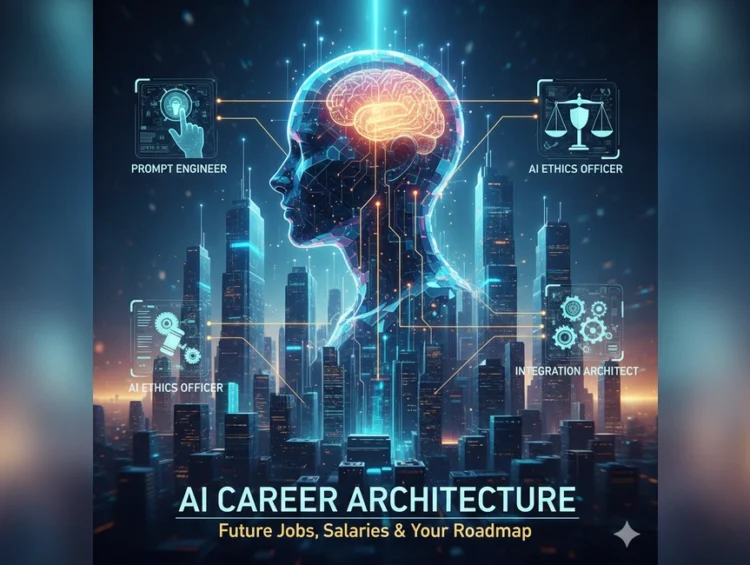
1. Prompt Engineering: Master Architects of Human-AI Interaction
2. AI Ethics & Compliance Officer: The Guardians of Fairness
3. AI Integration & Workflow Architect: Building Autonomous Loops
4. Explainability (XAI) Specialist: Decoding the Black Box
5. Synthetic Data Strategist: Solving the Global Data Drought
6. MLOps Engineer: The Backbone of Production AI
Case Study: How Future AI Jobs Are Reshaping Healthcare & Finance
Salary Analysis: Global Benchmarks for Future AI Jobs
Strategic Roadmap: 4 Steps to Pivot into Future AI Jobs
Conclusion: The Human Advantage
The Great Shift: Why Future AI Jobs Are the New Industrial Revolution
In 2025, we are witnessing a cognitive leap. While the industrial revolution replaced muscle with steam, the AI revolution is augmenting brainpower with silicon. According to the World Economic Forum (WEF) 2025 report, AI is projected to displace 85 million jobs while simultaneously creating 97 million new positions in human-machine collaboration.
The emerging landscape of Future AI Jobs is not just about writing code; it is about steering intelligence. We are moving from a world where we “perform the task” to a world where we “supervise the agent.” For professionals, this is not a threat—it is the greatest high-paying opportunity of the 21st century.
1. Prompt Engineering: Master Architects of Human-AI Interaction
Prompt Engineering has rapidly evolved from a “chat trick” to a core technical competency within the Future AI Jobs ecosystem.
The Why: LLMs (Large Language Models) are non-deterministic. A slight change in wording can lead to an “AI hallucination” or an inefficient response that wastes thousands of dollars in computing costs.
The Goal: To build systematic instruction pipelines (Chain-of-Thought, Tree-of-Thought) that ensure AI consistently delivers enterprise-grade results.
Strategic Impact: In 2030, every department—from marketing to legal—will have a Prompt Engineer who acts as the primary translator between business needs and machine execution.
2. AI Ethics & Compliance Officer: The Guardians of Fairness
As algorithms begin to make life-altering decisions in banking and hiring, the demand for an AI Ethics Officer is exploding.
The Mission: To audit AI models for bias, ensure they comply with the EU AI Act, and guarantee data privacy.
The Value: They prevent catastrophic reputational damage. If an insurance AI unintentionally discriminates based on demographics, the Ethics Officer is the person who prevents the resulting multi-billion dollar lawsuit.
3. AI Integration & Workflow Architect: Building Autonomous Loops
The “isolated chatbot” era is over. The high-value Future AI Jobs now lie in Agentic Workflows.
The Role: An Integration Architect doesn’t just use ChatGPT; they connect it to the company’s CRM, ERP, and communication tools.
The Purpose: To create autonomous loops where AI reads an email, checks the inventory, updates the database, and notifies the client—all without human intervention.
Reference: For technical integration frameworks, professionals often rely on OpenAI’s Platform Documentation.
4. Explainability (XAI) Specialist: Decoding the Black Box
“Because the AI said so” is not a valid legal or medical defense. Explainability Specialists are the “interpreters” of the Future AI Jobs world.
The Challenge: Deep learning models are “Black Boxes.”
The Solution: Using mathematical techniques (SHAP, LIME) to show exactly which data points led to an AI’s decision. This is critical for high-stakes industries like aerospace and surgery.
5. Synthetic Data Strategist: Solving the Global Data Drought
Experts warn that the internet will run out of high-quality human text by 2026. This has birthed one of the most niche Future AI Jobs: the Synthetic Data Strategist.
The Logic: They use AI to create artificial data sets that are statistically identical to real-world data but contain no sensitive personal information.
Case Study Example: Otonomous vehicle companies use synthetic data to simulate “rare crash” scenarios millions of times without a single real-world injury.
6. MLOps Engineer: The Backbone of Production AI
Building an AI model in a lab is easy; keeping it running efficiently for 1 million users is the hard part.
Responsibility: MLOps Engineers ensure that AI models don’t “drift” (get dumber over time) and that the server infrastructure scales alongside demand.
Case Study: How Future AI Jobs Are Reshaping Healthcare & Finance
In Healthcare, AI-driven diagnostics are now 45% faster in real-time insights compared to traditional manual report narratives. This has created a surge in “Medical AI Liaison” roles—professionals who bridge the gap between surgeons and diagnostic algorithms.
In Finance, banks like DHL and JP Morgan are using AI-powered robots to increase productivity by up to 180%. This has shifted clerical accounting roles into AI Solutions Architects, where the focus is on optimizing the automated ledger rather than manually checking it.
Salary Analysis: Global Benchmarks for Future AI Jobs (2025-2030)
The scarcity of talent in Future AI Jobs has led to unprecedented compensation packages.
| Job Title | Junior (US) | Senior (Global) | Demand Growth |
| Prompt Engineer | $95,000 | $330,000+ | 38% CAGR |
| AI Ethics Officer | $115,000 | $245,000 | High (Legal necessity) |
| AI Integration Architect | $140,000 | $305,000 | Extreme |
| MLOps Engineer | $120,000 | $220,000 | Steady |
For more detailed insights on AI pay scales, you can explore the 2025 Global AI Jobs Barometer.
Strategic Roadmap: 4 Steps to Pivot into Future AI Jobs
Step 1: Foundational Intelligence: Do not start with coding. Start with Logic. Understand how Transformers and Neural Networks think.
Step 2: No-Code Automation Mastery: Learn tools like Make.com and LangChain. If you can automate a business process without writing code, you are already halfway to becoming an AI Architect.
Step 3: Certification & Proof of Work: Degrees matter less than a portfolio. Build a “Custom GPT” that solves a real industry problem and document the results on GitHub or a personal blog.
Step 4: Niche Down: Don’t be a “general AI guy.” Be “The AI Prompt Expert for Litigation” or “The AI Ethicist for Retail.”
Conclusion: The Human Advantage
The emergence of Future AI Jobs is not the end of work; it is the beginning of high-value work. As the machine handles the “how,” humans must master the “why.” By developing your strategic thinking and ethical oversight, you can become an indispensable leader in the AI-driven economy of 2030.
Internal Links:
External Resources:
5 Best AI 3D Rendering Software for Students in 2026: The Ultimate Guide
10 Best AI Tools for Architects 2026: Transform Your Workflow Now