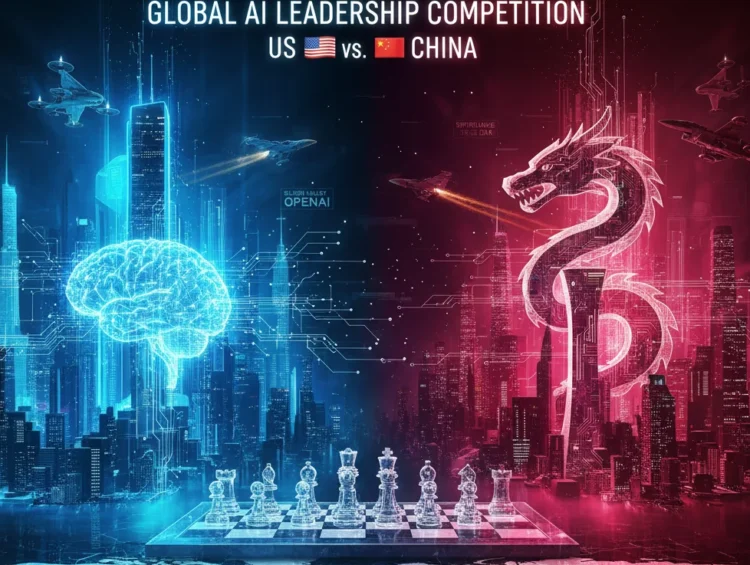
🇺🇸 China vs. 🇨🇳 America: The Global Race for AI Hegemony – An In-Depth Geopolitical and Scientific Analysis
Artificial Intelligence (AI) technologies are universally recognized as the most critical geopolitical contest of the 21st century. This struggle will determine not only technological superiority but also the future trajectory of global economic, military, and ideological norms. The Global AI Leadership Competition US China analysis highlights the relentless struggle between the US and the People’s Republic of China across the foundational pillars of the AI ecosystem: Talent, Data, Capital, Hardware, and Governance Models. This paper provides an in-depth, human-written, and academically rigorous comparison of both powers’ strategies, strengths, and vulnerabilities, using scientific and statistical evidence.
I. 🧠 Fundamental Research, Talent, and Academia: The Core of the Global AI Leadership Competition US China
Leadership in AI hinges upon the discovery of groundbreaking algorithms and the availability of highly skilled human capital to develop them. Talent is the critical long-term factor in the Global AI Leadership Competition US China.
A. The US: Center of Quality, Diversity, and Breakthrough Innovation
The US remains the pioneering force behind the theoretical foundations and the most widely adopted software frameworks in AI.
Academic Supremacy: Universities like MIT, Stanford, and Carnegie Mellon consistently dominate global rankings for the quality and citation count of AI publications. These institutions are the cradle of foundational research that shapes the future of AI (e.g., the Transformer architecture, reinforcement learning).
International Talent Pool: The US’s capacity to attract the world’s most talented researchers and engineers (including through immigration) through its attractive academic and industrial environment remains a key advantage. This brain drain maximizes the diversity and quality of US innovation.
Software Ecology: Open-source AI software frameworks like Google’s TensorFlow and Meta’s PyTorch set the global standard, increasing global reliance on the US software ecosystem.
B. China: Focus on Quantity, Speed, and Centralized Talent Development
China is executing a massive state-sponsored talent development program aimed at achieving its 2030 leadership goals.
Scale in Education: Chinese universities are rapidly outpacing the US in the number of AI-related graduates, quickly building the world’s largest pool of AI engineers.
Focus: While trailing the US in fundamental research, China aims to close this gap through applied sciences and accelerated industrial R&D, leveraging its massive internal market for deployment.
II. 💰 Capital and Private Sector Leadership: Fueling the Global AI Leadership Competition US China
The commercialization of AI innovation relies heavily on substantial venture capital (VC) inflows and the fierce competition among major technology giants. The financial war determines the pace of technology deployment.
A. The US: Dominance of Venture Capital and Big Tech
The US maintains a dominant position in funding the AI ecosystem.
Venture Capital (VC): The US attracts the largest share of global VC investment into AI startups. US VC flows significantly surpass China’s in recent years, facilitating rapid growth and commercialization.
Big Tech Companies: Companies like Alphabet, Microsoft, Amazon, Meta, and OpenAI, invest trillions in AI research, effectively controlling the global AI hardware and software infrastructure.
B. China: State-Backed Funds and Government Alignment
AI funding in China is centralized and coordinated, unlike the US market-driven approach.
Government Funds: China directs massive state-backed funds towards strategically selected AI domains (e.g., smart cities, autonomous vehicles).
Tech Giants: China’s tech giants—Baidu, Alibaba, Tencent, and Huawei—work closely in alignment with state technology policies, playing significant roles in large-scale infrastructure projects.
III. 💾 Hardware and Semiconductor Hegemony: The Critical Bottleneck in the Global AI Leadership Competition US China
Training and deploying advanced AI models require massive computational power derived from High-Performance Computing (HPC) and advanced Graphics Processing Units (GPUs). Hardware is the US’s strongest leverage point in the Global AI Leadership Competition US China.
A. US Design Superiority and China’s Dependency
Chip Design and Architecture: US-based companies like NVIDIA (GPUs), AMD, and Intel maintain absolute dominance in the design and architecture of high-performance neural network accelerators.
Supply Chain Restrictions: The US government has imposed strategic export control mechanisms to limit China’s access to the most advanced semiconductors required for cutting-edge AI development. These restrictions represent a critical strategic vulnerability for China.
B. China’s Localization Efforts
China has prioritized reducing external hardware dependency as a national security imperative. While progress is made by local chip firms, dependency on foreign technology remains for the most advanced manufacturing nodes (7nm and below).
IV. 📏 Data Advantage and Speed of Application: The Fuel of AI
Data is the fuel of AI. In this domain, China holds a unique, structural advantage due to its social structure and data management culture.
A. China: Unrestricted Data Pool and Application Scale
Data Collection: Under governmental oversight, China possesses a massive, centralized, and relatively unrestricted pool of data available for training AI systems. The absence of strict Western-style individual data privacy laws facilitates faster and more comprehensive model training.
Application Speed: China leads the US in the speed and scale of deploying and integrating AI technologies into daily life (e.g., smart cities, surveillance, and mobile payments). China acts as a vast operational laboratory for AI solutions.
B. The US: Privacy Barriers and Data Diversity
Strict US data privacy laws (e.g., CCPA, HIPAA) constrain data sharing for AI training. However, the US’s open society provides access to more diverse and globally representative datasets, which can enhance the models’ generalizability and robustness.
V. ⚖️ Governance Models and Ideological Conflict in the Global AI Leadership Competition US China
The Global AI Leadership Competition US China is also an ideological conflict over which governance model and ethical framework will become the global norm for AI.
VI. Conclusion and Geopolitical Outlook: The Balance of Leadership
There is no single, clear winner; leadership is a fluid balance dependent on the measured domain.
US Critical Edge (Depth and Quality): The US leads arguably in foundational AI theory, the most advanced Large Language Models (LLMs), and chip design. These breakthroughs form the basis for future technological leaps.
China’s Operational Edge (Speed and Scale): China leads in the speed of AI technology integration into society, access to vast data pools, and centralized strategic coordination. It outpaces the US in the rapid, large-scale deployment of AI solutions.
The ultimate rule of the Global AI Leadership Competition US China is simple: whichever model sets the global standards for the development and deployment of AI will secure the future superpower status.
20 Essential AI Tools for Content Creation: The Ultimate Guide to Scaling Quality



[…] Global AI Leadership Competition US China […]