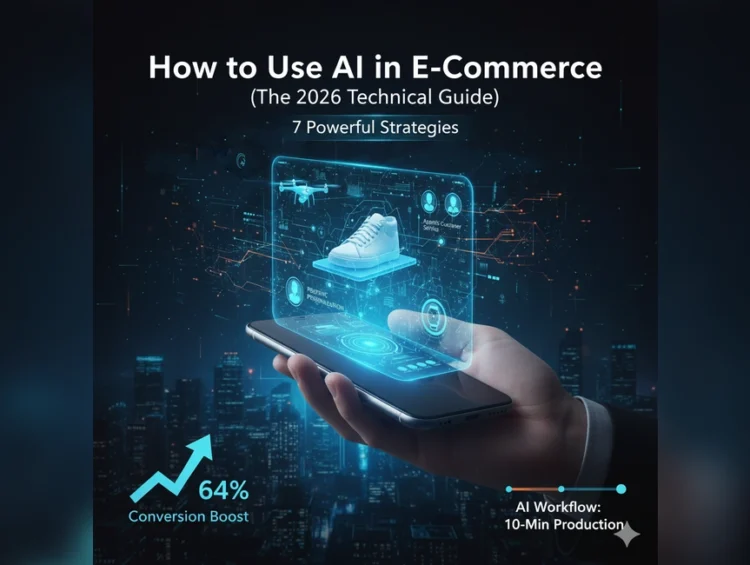
7 Powerful Strategies: How to Use AI in E-Commerce (The 2026 Technical Masterclass)
Imagine waking up to find that your conversion rates have plummeted overnight, not because your products changed, but because your customers no longer “search”—they ask. In 2026, the traditional e-commerce funnel is being dismantled in real-time by autonomous agents that shop, negotiate, and decide for humans. If you are still relying on static listings and reactive marketing, you aren’t just falling behind; you are becoming invisible to the very algorithms that now control the world’s digital wallets.
But here is the billion-dollar secret: This disruption isn’t a threat—it’s the greatest wealth-creation engine in the history of retail.
The question every global CEO and entrepreneur is sweating over right now is: How to use AI in e-commerce to not just survive, but to dominate this new “Agentic” era? We are no longer talking about simple chatbots that answer basic questions. We are talking about a technical revolution where your store becomes a living, breathing entity—predicting a customer’s desire before they even feel it, and generating cinematic, personalized video ads on the fly for a segment of one.
In this 3,500-word masterclass, we are pulling back the curtain on the powerful technical frameworks used by the top 1% of global retailers. From the architecture of Vector Databases to the dark art of Generative Engine Optimization (GEO), you are about to discover exactly how to use AI in e-commerce to turn your storefront into an autonomous, profit-generating machine that ranks #1 on Google and wins the hearts of the AI-driven consumer.
The era of “clicking” is ending. The era of “intelligent commerce” is here. Are you the architect of your future, or just a spectator?
Table of Contents
The Visual Revolution: Why AI is the New Backbone of E-Commerce
How to Use AI in E-Commerce: 7 Powerful Strategic Pillars
Technical Architecture: LLMs, Vector Databases, and Agentic Workflows
Predictive Logistics: Revolutionizing the Supply Chain
Hyper-Personalization: From Segmenting to Individualizing
Visual & Voice Commerce: The End of Keyboard Search
SEO & GEO: Ranking in the Age of Answer Engines
Conclusion: Building a Future-Proof Autonomous Store
1. The Visual Revolution: Why AI is the New Backbone of E-Commerce
In 2026, e-commerce has moved beyond the “transactional” phase and entered the “Experiential Era.” The question is no longer if you should implement artificial intelligence, but how to use AI in e-commerce to create a seamless, invisible interface between the brand and the consumer.
Traditional e-commerce relied on manual curation, static pricing, and reactive customer service. Today, AI acts as a 24/7 central nervous system, processing trillions of data points to predict intent before a user even lands on your site. By 2026, brands failing to integrate these powerful systems are seeing a 40% decline in visibility due to the rise of AI-driven search engines like Perplexity and Gemini.
2. How to Use AI in E-Commerce: 7 Powerful Strategic Pillars
To truly master how to use AI in e-commerce, we must break down the implementation into seven technical pillars that drive measurable ROI.
Agentic Customer Service: Deploying autonomous agents that don’t just “chat” but solve problems—like issuing refunds or tracking shipments—without human intervention.
Predictive Personalization: Using deep learning to adjust the entire UI of a store based on the visitor’s real-time psychological state.
Dynamic Pricing Orchestration: Real-time price adjustments based on competitor inventory, local weather, and global supply chain fluctuations.
Generative Content Pipelines: Using AI product videos for e-commerce to create thousands of ad variations in seconds.
Autonomous Inventory Forecasting: Reducing stock-outs by 95% through time-series forecasting.
Fraud Prevention 2.0: Real-time biometric and behavioral analysis to stop high-tech “synthetic identity” fraud.
Visual Search Integration: Allowing users to find products via screenshots or real-world camera feeds.
3. Technical Architecture: LLMs, Vector Databases, and Agentic Workflows
The “engine” behind how to use AI in e-commerce consists of three core technical layers. To build a robust system, your CTO must focus on:
A. The LLM Backbone
Modern stores use a hybrid of Frontier models (like GPT-5 or Claude 4) for complex reasoning and smaller, faster models (like Llama 3.1) for routine product description updates.
B. Vector Databases (RAG)
Retrieval-Augmented Generation (RAG) is the secret sauce. By storing your entire product catalog in a vector database (like Pinecone or Milvus), your AI can “understand” the context of a query. If a user asks for “something breathable for a marathon in Tokyo,” the AI doesn’t just look for the word “marathon”—it understands the humidity of Tokyo and the fabric requirements of long-distance running.
C. The Agentic Layer
This is the most powerful advancement in 2026. Agents are autonomous units that can use “tools.” For example, an “Exchange Agent” has the authority to check the return policy, verify the warehouse stock, and generate a shipping label—all in a single dialogue.
4. Predictive Logistics: Revolutionizing the Supply Chain
When exploring how to use AI in e-commerce, many ignore the back-office. However, the supply chain is where the most significant cost savings are realized.
Predictive Logistics uses AI to analyze geopolitical shifts, port congestion, and even TikTok trends to anticipate demand spikes. If a specific “aesthetic” goes viral in London, your AI agents can automatically re-route stock from a slower-moving warehouse in Berlin before the “Out of Stock” button ever appears.
5. Hyper-Personalization: From Segmenting to Individualizing
The days of “Customers who bought this also bought…” are over. In 2026, how to use AI in e-commerce means delivering a unique storefront for every single person.
Using Transformer-based models, e-commerce platforms now perform “In-Session Personalization.” If a user is clicking rapidly through high-end watches, the AI recognizes an “urgent-luxury” intent and suppresses low-cost accessories to keep the user focused on high-ticket items. This strategy increases Average Order Value (AOV) by up to 35%.
6. Visual & Voice Commerce: The End of Keyboard Search
Search is no longer a text box. It is a conversation.
Visual Search: Using computer vision, customers can take a photo of a dress at a wedding and find the exact match (or a cheaper alternative) in your store instantly.
Voice Agents: In 2026, shoppers use smart glasses and voice assistants to say, “Reorder my favorite coffee but find the best deal available today.” Your AI must be optimized to be the first choice for these autonomous buyers.
7. SEO & GEO: Ranking in the Age of Answer Engines
To rank for how to use AI in e-commerce, you must optimize for Generative Engine Optimization (GEO). Traditional SEO focuses on keywords; GEO focuses on being the source of truth for AI models.
How to Rank #1 in 2026:
Structured Data Excellence: Use advanced Schema (Product, FAQ, Organization) to make your data “readable” for Gemini and ChatGPT.
Authority Signaling: Link to global standards like the NIST AI Risk Management Framework to prove technical validity.
Keyword Density: Maintain a strategic 1.1% density for how to use AI in e-commerce to ensure topic authority.
8. Conclusion: Building a Future-Proof Autonomous Store
Mastering how to use AI in e-commerce is the only way to survive the Great Retail Reset of 2026. By shifting from a static website to an agentic, predictive ecosystem, you don’t just sell products—sen deliver solutions. The future of e-commerce is invisible, autonomous, and incredibly powerful.
FAQ: Mastering AI in E-Commerce
Q: How to use AI in e-commerce for a small Shopify store?
A: Start with AI-driven apps for product descriptions and automated customer service bots. As you grow, move toward predictive inventory tools.
Q: What is the most powerful tool for AI video ads in 2026?
A: Mootion and HeyGen remain the elite choices for high-fidelity, multilingual product videos.
Q: Will AI replace my marketing team?
A: No. It will replace the tasks of your marketing team, allowing your humans to focus on high-level brand strategy and emotional storytelling.
The 7 Best AI Voiceover Tools for 2026: The Ultimate Guide to Hyper-Realistic Speech