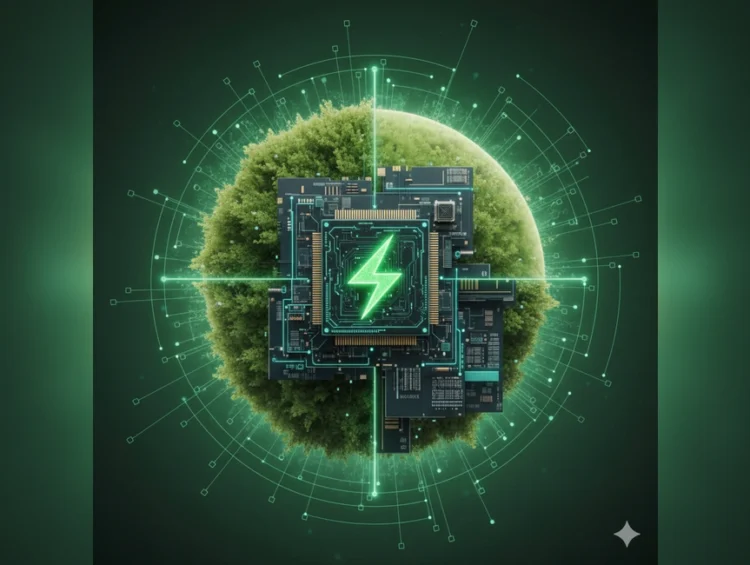
Sustainability in Generative AI Hardware: The Definitive Guide to Green Computing in 2030
The rapid rise of large language models (LLMs) like GPT-4, Claude, and Gemini has inaugurated a new era of human productivity. However, this intelligence comes with a staggering physical cost. Sustainability in generative AI hardware is no longer a peripheral topic for environmentalists; it is now the core strategic challenge for the semiconductor and cloud computing industries.
To achieve net-zero intelligence, we must move beyond the “compute at any cost” mentality and embrace a new architecture designed for energy efficiency.
Table of Contents
The Energy Crisis of Artificial Intelligence
Every query sent to a generative AI model consumes significantly more power than a standard Google search. According to the International Energy Agency (IEA), a single ChatGPT request consumes approximately $2.9$ watt-hours of electricity, compared to $0.3$ watt-hours for a Google search. If AI integration continues at this pace, the energy demand from data centers could reach $1,000$ terawatt-hours by 2026—roughly the total electricity consumption of Japan.
The foundation of sustainability in generative AI hardware lies in addressing this disparity through radical innovation in how we build and power silicon.
1. Beyond GPUs: The Rise of ASICs, NPUs, and LPUs
For the last decade, Graphics Processing Units (GPUs) have been the workhorses of AI. However, GPUs are “general-purpose” by nature, meaning they carry overhead for tasks that AI models don’t actually need.
ASICs (Application-Specific Integrated Circuits): Chips like Google’s TPU (Tensor Processing Unit) are custom-built for tensor operations. They offer superior performance-per-watt compared to traditional GPUs.
LPUs (Language Processing Units): Startups like Groq have developed LPUs that eliminate the memory bottleneck of GPUs. By focusing purely on inference, these chips achieve unprecedented speed while maintaining high sustainability in generative AI hardware.
NPUs (Neural Processing Units): Now found in consumer laptops and smartphones, NPUs allow AI tasks to run locally on low power, reducing the need for energy-intensive cloud round-trips.
2. Liquid Cooling and Submerged Infrastructure
Standard air-cooling systems in data centers are incredibly wasteful; in many cases, up to $40\%$ of a facility’s total energy is spent just on keeping the servers from melting.
Sustainability in generative AI hardware is being revolutionized by Liquid Immersion Cooling. By submerging entire server racks into specialized, non-conductive dielectric fluids, heat is transferred much more efficiently than through air.
Heat Recovery: This hot fluid can then be piped into municipal heating systems for nearby cities, turning a “waste product” (heat) into a valuable resource.
Density: Liquid cooling allows for tighter server packing, reducing the physical footprint of data centers by up to $70\%$.
3. Sustainable Data Center Design: The Nordic Model
Location is destiny when it comes to sustainability in generative AI hardware. We are seeing a massive shift of AI training clusters to the “Nordic Model”—regions like Iceland, Norway, and Sweden.
Natural Cooling: The cold climate provides free ambient cooling for much of the year.
Renewable Abundance: These regions offer consistent geothermal and hydroelectric power, ensuring that the “carbon intensity” of every AI training run is near zero.
Microgrids: Future data centers will operate as independent microgrids, using AI to manage their own battery storage and renewable inputs.
4. Algorithmic Efficiency: Distillation and Quantization
The hardware is only half the battle. Sustainability in generative AI hardware is deeply linked to how models are optimized to run on that hardware.
Quantization: Reducing a model’s weight precision from $16$-bit to $8$-bit or even $4$-bit. This allows larger models to fit onto smaller, less power-hungry chips without significant loss in accuracy.
Knowledge Distillation: Training a smaller “student” model to mimic a larger “teacher” model. This allows for mobile-friendly AI that consumes milliwatts instead of kilowatts.
5. Neuromorphic Computing: The Brain-Inspired Future
If we want to achieve true sustainability in generative AI hardware, we must look at the most efficient computer known to man: the human brain. Neuromorphic chips, such as Intel’s Loihi, mimic the way neurons and synapses work.
Unlike traditional chips that are “always on,” neuromorphic systems only consume power when a “spike” (a data signal) occurs. This “event-driven” architecture could potentially reduce AI energy consumption by a factor of $1,000$.
6. The Role of Circular Economy in Hardware Manufacturing
Sustainability isn’t just about energy use during operation; it’s about the “embodied carbon” in the hardware itself. The mining of rare earth metals for AI chips has a high environmental cost.
Modular Design: Future AI servers will be designed with modularity in mind, allowing individual components (like HBM memory or core chipsets) to be upgraded without discarding the entire board.
Recycling Programs: Leading hardware providers are implementing closed-loop systems to recover precious metals from decommissioned GPUs.
7. Global Regulations and ESG Standards for AI
Governments are beginning to mandate transparency in AI energy usage. The EU AI Act and new ESG (Environmental, Social, and Governance) reporting standards will soon require companies to disclose the carbon footprint of their AI models.
Sustainability in generative AI hardware will soon become a legal requirement, not just a corporate social responsibility goal. Companies that invest in green hardware now will avoid future “carbon taxes” and regulatory penalties.
Conclusion: Scaling Intelligence Responsibly
The path to sustainability in generative AI hardware is paved with both challenges and immense opportunities. As we scale toward Artificial General Intelligence (AGI), our success will be measured not just by the complexity of our models, but by our ability to power them without depleting our planet’s resources.
By integrating specialized silicon, liquid cooling, and neuromorphic designs, we can ensure that the AI revolution is a green one. The future of intelligence is not just bright—it is sustainable.
AI in 2030: 5 Massive Revolutions That Will Change Our Lives




[…] Sustainability in Generative AI Hardware: The Definitive Guide to Green Computing in 2030 […]
[…] Sustainability in Generative AI Hardware: The Definitive Guide to Green Computing in 2030 […]
[…] Sustainability in Generative AI Hardware: The Definitive Guide to Green Computing in 2030 […]
[…] Sustainability in Generative AI Hardware: The Definitive Guide to Green Computing in 2030 […]