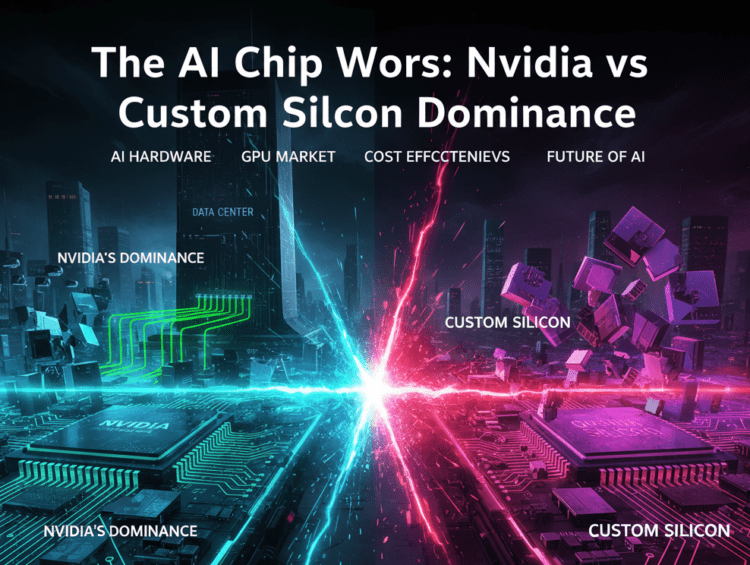
The AI Chip Wars: Why Nvidia’s Dominance is Being Challenged by Custom Silicon
The rise of AI Chips, AI Hardware, and Custom Silicon defines the next era of technological competition. This article delves into why the seemingly unbreakable Nvidia Dominance is under attack, explores the leading Technology Trends driving this revolution, and analyzes how the battle over the Semiconductor industry will reshape the future of High Performance computing.
Introduction: AI’s Gold Rush and the Hardware Undercurrent
Over the last decade, the relentless ascent of Machine Learning and Deep Learning has placed the processing of colossal datasets at the very core of the global tech economy. The unsung hero of this revolution has been the underlying AI Hardware—the specialized processors known as AI Chips that train and run these sophisticated models. For years, one undisputed monarch ruled this domain: Nvidia.
However, the sheer complexity of modern AI applications and the astronomical Data Center costs required to sustain them have created an inevitable friction point. This pressure is giving rise to a new, powerful challenger to Nvidia Dominance: Custom Silicon (Application-Specific Integrated Circuits, or ASICs). The Chip Wars have officially commenced, and the outcome will redefine everything from Cloud Computing to autonomous vehicles. The question isn’t if the landscape will change, but how fast.
1. The Anatomy of Nvidia’s Empire: Software as the Ultimate Weapon
Nvidia’s power in the AI Chips market is not solely due to its superior AI Hardware; its true, almost impenetrable fortress lies in its software ecosystem.
A. CUDA: The AI Development Standard
The foundation of Nvidia’s absolute hegemony in the GPU Market is its parallel programming platform, CUDA, which has been developed and refined for over a decade. CUDA provided developers with the necessary tools to efficiently run their algorithms on GPUs, essentially standardizing AI development.
The Ecosystem Lock-in: The vast majority of Machine Learning researchers and practitioners built their workflows and academic contributions upon CUDA. This meant that rivals attempting to break into the market had to compete not just with a piece of Semiconductor hardware, but with an immense, established ecosystem of software libraries and a devoted developer AI Community.
The First-Mover Advantage: Nvidia recognized the Technology Trends early, seeing that GPUs were ideal not only for graphics but also for parallel processing. This foresight granted the company a decade-long lead that remains challenging for competitors to overcome entirely.
This robust foundation made Nvidia the de facto choice for every Data Center demanding High Performance processing power.
2. The Custom Silicon Counter-Attack: Challenging the Generalist
Custom Silicon solutions—highly specialized processors—are the chief combatants currently destabilizing the Yapay Zeka Çipleri market. These challengers range from silicon designed by tech titans for internal use to innovative Design Solutions emerging from nimble AI startups.
B. The Internal Necessity of Cloud Giants
Cloud Computing behemoths (Google, Amazon, Microsoft) are investing billions in designing their own Custom Silicon to reduce their reliance on Nvidia and maximize Cost Effectiveness.
Google TPUs (Tensor Processing Units): Designed specifically for Google’s internal Machine Learning frameworks (like TensorFlow), TPUs offer highly specialized High Performance and superior efficiency for their proprietary models.
AWS’s Trainium and Inferentia: Amazon’s chips specifically target the two distinct phases of AI: Training and Inference. By offering tailored Design Solutions, AWS provides its clients with compelling alternatives to the Nvidia Dominance.
For these massive players, developing Custom Silicon is not just about reducing cost; it’s about providing unique, optimized services that ensure a competitive edge in the ruthless Bulut Bilişim space.
3. The Core Drivers of the Chip Wars: Economics and Specialization
The intensity of these Chip Wars is driven by undeniable economic pressures and fundamental technical constraints.
C. The Divergence of Training and Inference
The two core phases of developing and deploying an Artificial Intelligence Model—Training and Inference—have dramatically different hardware needs, which general-purpose GPUs struggle to meet optimally.
Training Demands: This stage involves immense, sustained Deep Learning computations over weeks or months, requiring peak High Performance and massive memory bandwidth.
Inference Demands: This is when the model is used in real-time (e.g., serving website predictions or mobile apps). Here, the priority shifts to Cost Effectiveness, low latency, and energy efficiency.
Specialized Semiconductor architectures designed exclusively for Training and Inference can perform these specific tasks with far greater energy efficiency and lower total cost of ownership compared to general-purpose GPUs. This specialization is vital for the long-term economic sustainability of Data Center operations.
D. The Triumph of Cost Effectiveness and AI Democratization
The massive energy and monetary costs associated with large-scale Machine Learning models are proving unsustainable for many organizations.
AI Democratization: The drive for Cost Effectiveness is fueling AI Democratization. When the hardware to run powerful models becomes cheaper, smaller companies and researchers gain access, accelerating Future and Innovation outside the handful of global technology centres.
Edge AI: Modern Technology Trends indicate a shift toward running AI directly on devices (Edge AI). This requires AI Hardware that is extremely power-efficient—a domain where compact, purpose-built Custom Silicon excels, moving beyond the traditional GPU Market.
Conclusion: The Inevitable Evolution of the Semiconductor Landscape
The Nvidia Dominance remains a formidable presence in the AI Chips domain, largely protected by its software moat. However, the challenge from Custom Silicon is not a passing trend; it is the inevitable evolution of the Semiconductor industry driven by economic necessity.
These Chip Wars are fostering unparalleled competition, pushing the future of AI Hardware to be faster, more efficient, and more affordable. The days of a single, dominant processor type ruling all AI tasks are numbered. The future promises a diversified, specialized ecosystem where a variety of Design Solutions are optimized for every stage of the Machine Learning process, offering the greatest possible High Performance and opening up vast new horizons for Future and Innovation.