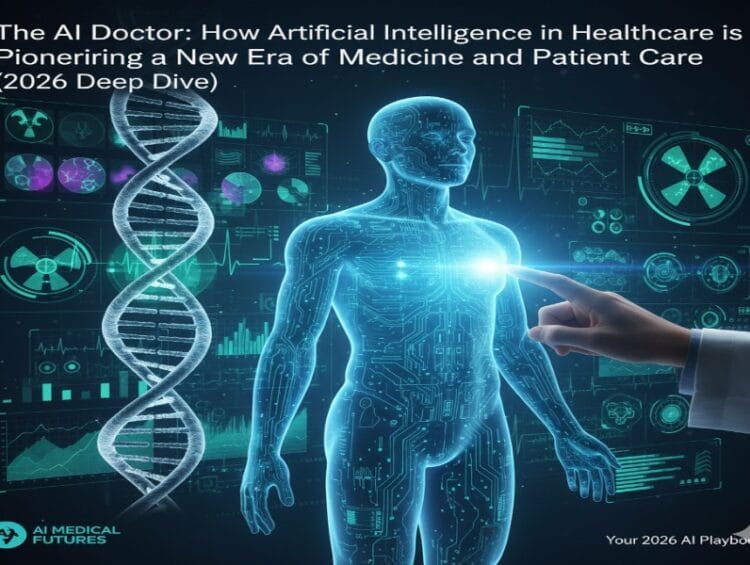
The AI Doctor: How Artificial Intelligence in Healthcare is Pioneering a New Era of Medicine and Patient Care (2026 Deep Dive)
The global healthcare system stands at a monumental crossroads in 2026. Faced with critical challenges such as exponentially escalating operational costs, the increasing burden of chronic diseases, and the necessity to manage petabytes of heterogeneous clinical data, the sector is undergoing its most profound transformation yet, driven almost entirely by the rigorous application of Artificial Intelligence (AI). Artificial Intelligence in Healthcare is no longer a speculative or conceptual tool; it is the fundamental infrastructure enabling quantifiable precision medicine, predictive diagnostics, and scalable patient care worldwide.
While early applications focused on basic administrative tasks, the current generation of AI is deeply embedded in the clinical workflow, executing tasks that demand high-level cognitive processing and pattern recognition. This systemic shift promises not only significant operational efficiencies and fiscal optimization but also unparalleled accuracy and consistency in diagnostic and therapeutic decision-making.
This comprehensive, data-informed analysis will explore the most impactful advancements and technical mechanisms within Artificial Intelligence in Healthcare across diagnostics, drug discovery, clinical operations, and patient management. By dissecting these complex applications, healthcare professionals, investors, and policymakers can strategically position themselves for technical leadership and success in this AI-augmented medical future.
The Core Transformation: Quantifying Artificial Intelligence in Healthcare
The true power of Artificial Intelligence in Healthcare resides in its capacity to process and interpret massive, unstructured, and multi-modal datasets—including high-resolution medical images, extensive genomic sequences, complex clinical notes, and granular physiological data—at speeds and scales beyond human cognitive capacity. This capability yields three primary, scientifically measurable benefits that redefine the medical value chain:
Computational Speed and Throughput: Reducing the latency for complex tasks, such as drug compound screening or diagnostic image processing, from hours to seconds.
Diagnostic Accuracy and Reliability: Minimizing human-introduced variability and error in complex pattern recognition, achieving inter-rater reliability scores often exceeding human expert consensus.
Scalability and Access: Enabling the deployment of specialized medical expertise (via algorithms) to resource-constrained, remote populations globally, thereby mitigating geographic and economic disparity in care access.
The integration of advanced deep learning (e.g., Convolutional Neural Networks for vision and Transformer models for language) is forging a new evidence-based standard of care where every medical decision is informed by rigorously analyzed historical data.
I. AI in Diagnostics: Enhancing Clinical Accuracy and Speed via Deep Learning
The application of Artificial Intelligence in Healthcare in diagnostics involves the integration of highly specialized deep learning models to augment human perceptual and analytical limits.
A. Radiology and Medical Imaging Analysis
AI models, often utilizing Convolutional Neural Networks (CNNs), are trained on millions of expertly labeled medical scans. These systems now function as highly accurate “co-pilots,” adept at detecting minute, sub-visual anomalies indicative of early-stage pathologies (e.g., malignant microcalcifications, subtle stroke markers, or early cardiac dysfunction). This capability not only reduces false negatives but also dramatically decreases the required time for initial image interpretation and critical case prioritization.
B. Pathology and Precision Cancer Detection
Artificial Intelligence in Healthcare is revolutionizing pathology through Digital Image Analysis. Algorithms precisely quantify cellular features, identify subtle malignant patterns in complex biopsies, and use Graph Neural Networks (GNNs) to model cell-to-cell interactions, predicting the potential aggressiveness and metastatic risk of tumors. This transition transforms pathology from a qualitative, experience-driven discipline into a highly quantitative science, enabling superior patient stratification for targeted oncological treatments.
C. Predictive Risk Scoring and Proactive Intervention (Machine Learning)
Beyond visual data, AI synthesizes heterogeneous data from Electronic Health Records (EHRs), biomarkers, and physiological sensor data. These Machine Learning (ML) models create dynamic, longitudinal predictive risk scores for chronic and acute events (e.g., sepsis onset, heart failure readmission). This proactive intervention capability leverages the power of time-series analysis to initiate preventive treatments before the symptomatic manifestation of disease, embodying the essence of preventative medicine.
II. Revolutionizing Drug Discovery and Genomics with Artificial Intelligence in Healthcare
The substantial resource expenditure and inherent failure rate in pharmaceutical development are being fundamentally disrupted by computational power and advanced modeling.
A. Target Identification and Novel Compound Generation
AI algorithms leverage Generative Adversarial Networks (GANs) and other generative models to identify novel disease targets, predict the binding kinetics and efficacy of billions of virtual compounds, and design entirely de novo small molecules in silico. This massive computational screening advantage significantly de-risks and accelerates the pre-clinical stage. The ability of Artificial Intelligence in Healthcare to synthesize and test complex chemical spaces virtually represents a paradigm shift in biopharma R&D.
B. Genomics and Precision Pharmacogenomics
Integrating AI with multi-omics data allows for precision medicine at a molecular level. AI analyzes an individual’s unique genetic code to predict specific drug metabolism rates or therapeutic response profiles (Pharmacogenomics). This capability minimizes the risk of adverse drug reactions (ADRs) and ensures the immediate application of the most efficacious therapeutic protocol, which is particularly vital in rapidly evolving or highly individualized diseases.
C. Clinical Trial Optimization and Cohort Selection
AI models optimize clinical trial protocols by simulating patient outcomes under varying conditions. Artificial Intelligence in Healthcare algorithms select ideal patient cohorts (those most likely to exhibit a clear therapeutic effect) and monitor trial data integrity in real-time, leveraging sophisticated statistical inference to manage adaptive trial designs. This reduces recruitment latency and overall operational expenditure.
III. Enhancing Clinical Operations and Workflow Efficiency
The strategic use of AI in operational management aims to maximize clinician throughput and minimize system friction, ensuring that highly skilled human resources are focused on complex patient interaction.
A. Administrative Automation and Revenue Cycle Management
Intelligent automation platforms utilize Robotic Process Automation (RPA) and machine learning to manage complex administrative tasks, including automated insurance eligibility verification, accurate procedure coding, and predictive denial management in the revenue cycle. This application of Artificial Intelligence in Healthcare significantly stabilizes hospital finances by reducing denial rates and accelerating reimbursement timelines.
B. Medical Documentation and Advanced Scribing via NLP
Addressing clinician burnout, advanced Natural Language Processing (NLP) models (e.g., domain-specific large language models) transcribe and interpret physician-patient dialogue. These systems automatically draft structured clinical notes, populate the Electronic Health Record (EHR) fields, and suggest precise diagnostic/billing codes. This reduces the administrative load by hours, redirecting clinician focus back to the patient.
C. Hospital Logistics and Resource Allocation (Simulation and Optimization)
AI models utilize advanced Queuing Theory and Discrete Event Simulation to predict dynamic variables, such as patient admission/discharge flow, elective surgery scheduling bottlenecks, and optimal staffing levels within intensive care units. This application of Artificial Intelligence in Healthcare ensures efficient resource deployment during demand fluctuations and minimizes critical service delays.
IV. Transforming Patient Engagement and Virtual Care
The patient experience is being fundamentally reshaped by AI-driven, accessible, and personalized digital interfaces.
A. AI-Powered Chatbots and Virtual Triage
Patient-facing conversational AI agents (often LLM-backed) provide immediate symptom checking, personalized health information, and automated triage, guiding patients to the appropriate level of care based on risk assessment protocols. These sophisticated Artificial Intelligence in Healthcare tools act as scalable filters, ensuring that urgent cases bypass unnecessary administrative delay.
B. Remote Patient Monitoring (RPM) and Personalized Coaching
AI analyzes continuous, multi-stream physiological data from wearable and home devices. Deep learning models detect subtle, non-linear changes indicative of health deterioration (e.g., precursors to cardiac events or respiratory decompensation). The system then autonomously delivers personalized, evidence-based coaching and alerts, dramatically reducing preventable hospital readmissions by managing chronic conditions effectively at home.
C. Mental Health Support and Digital Therapeutics (Voice Analysis)
NLP and Voice Analysis Algorithms analyze linguistic and paralinguistic features (tone, pitch, pause frequency) to detect early indicators of cognitive decline, depression, or anxiety. AI platforms then deliver scalable Digital Therapeutic (DTx) interventions, expanding access to behavioral health support using clinically validated content.
V. Governance, Ethics, and the Future Symbiosis of Artificial Intelligence in Healthcare
The integration of AI necessitates stringent ethical and regulatory frameworks to ensure safety, fairness, and compliance across global health systems.
A. Data Privacy, Security, and Confidentiality Protocols
Given the hyper-sensitive nature of medical data, effective Artificial Intelligence in Healthcare mandates the use of robust privacy-preserving techniques. Federated Learning (training models on decentralized, local data sources) and Differential Privacy (introducing statistical noise to mask individual identities) are critical architectural decisions ensuring compliance with regulations like HIPAA and GDPR. Data governance must be secure by design.
B. Bias Mitigation and Health Equity
AI models trained on skewed or non-diverse historical patient data can inadvertently amplify existing health disparities, leading to inequitable diagnostic or treatment outcomes for underrepresented populations. Ethical development of Artificial Intelligence in Healthcare requires continuous auditing and active recalibration of training datasets to ensure algorithmic fairness and promote global health equity.
C. Regulatory Oversight and Explainable AI (XAI)
The “black box” nature of complex deep learning models presents a significant hurdle for regulatory approval. Clinicians and certifying bodies require Explainable AI (XAI) methodologies (e.g., LIME or SHAP values) to understand the mechanistic causality—why a specific diagnosis or treatment recommendation was rendered. Regulatory pathways must evolve to certify these rapidly adaptive technologies safely.
D. The Clinician-AI Symbiosis: Redefining Medical Expertise
The future of medicine is fundamentally defined by human-AI collaboration, not replacement. Artificial Intelligence in Healthcare handles complex data processing and pattern synthesis; the human clinician retains ultimate responsibility for critical decision-making, ethical judgment, and delivering empathetic patient communication—the indispensable, human components of medicine. Success hinges on advanced medical education that integrates AI literacy and critical evaluation of model outputs.
Conclusion: Pioneering the AI-Augmented Care Model
The year 2026 solidifies AI’s role as the indispensable partner in the medical world. From radically shortening the journey of a new drug from the lab bench to the patient bedside, to ensuring every patient receives a rapid, data-informed, and personalized diagnosis, the current Artificial Intelligence in Healthcare applications are unprecedented in their scope and potential for global impact.
For stakeholders—whether an innovator, a policymaker, or a care provider—the strategic imperative is clear: embrace the technical transition. Investing in robust data infrastructure, championing diverse and ethical data governance policies, and fostering the vital, collaborative symbiosis between human expertise and validated machine intelligence will be the defining factors for leadership and ethical success in the new era of AI-augmented medicine. The AI Doctor is fully integrated, and the prognosis for global health is stronger than ever before.
The Rise of AI Coding Assistants: How Machines Are Rewriting the Future of Software Development


[…] The AI Doctor: How Artificial Intelligence in Healthcare is Pioneering a New Era of Medicine and Pat… […]