1. Introduction: The AI Age Workforce – A Manifesto of Evolution
The rapid ascent of Artificial Intelligence (AI) technologies, particularly Generative AI and Large Language Models (LLMs), has positioned the global labor market at a critical inflection point. While anxieties persist about automation displacing jobs, the reality is far more nuanced and complex. AI rarely eliminates entire professions; rather, it fundamentally redefines the tasks within them.
This comprehensive and instructive guide will delve deeply into the intersection of AI and Employment. Our goal is not merely to catalogue which jobs are changing, but to provide concrete upskilling and reskilling strategies that enable both individuals and organizations to proactively prepare for this inevitable workforce transformation.
We will focus on the essential AI skills and human competencies—the soft skills—required to thrive in this new era, aiming to equip our readers to confidently position themselves for the future of work.
2. The Economic Impact of Automation: The Changing Core of Work
The rise of AI does not result in an overnight disappearance of professions. Instead, it selectively automates tasks within those professions. This phenomenon is often termed “task automation” by economists.
2.1. Task Automation and the Efficiency Dividend
The ascent of automation is most pronounced in tasks that are repetitive, rule-based, and involve large-scale data processing. These functions are ideally suited for AI and Robotic Process Automation (RPA):
Finance and Accounting: Invoice reconciliation, credit scoring for risk assessment, and core payroll processing are executed flawlessly in seconds by AI algorithms. Human roles shift towards verifying these outputs, providing complex financial advice, and developing strategic plans.
Legal and Administrative Fields: LLMs dramatically speed up tasks like e-discovery (sifting through legal documents) and initial drafting of legal briefs, which previously took weeks. Legal professionals are freed up to focus on strategic client relationships and the complex interpretation of legal precedents.
Software Development: AI co-pilots like GitHub Copilot automate tasks like code completion and writing boilerplate functions. The developer’s primary focus moves from low-level coding to high-level system architecture, code quality assurance, and complex problem-solving.
This automation wave has the potential to boost corporate productivity by 30% to 50%.
2.2. The Anatomy of New Roles: The Three Pillars of the AI Economy
One of the most significant shifts in AI and Employment is the creation of entirely new roles demanding novel skill sets. These new jobs typically fall into three primary categories:
AI Builders: These professionals construct the AI systems themselves. (e.g., Machine Learning Engineers, Data Scientists, AI Researchers, Data Engineers).
AI Supervisors: These roles ensure the performance, accuracy, reliability, and ethical compliance of AI systems. (e.g., Prompt Engineers, AI Ethics and Governance Specialists, AI Safety Analysts).
AI Interpreters/Users: These professionals utilize AI tools (Generative AI, Copilots) masterfully in their daily work to optimize workflows. (e.g., AI-Assisted Content Strategists, Data-Driven Marketing Specialists).
This indicates that nearly every position in the future will require baseline AI skills to remain competitive.
3. Critical Upskilling Strategies: Essential AI Skills for the Future
Given the disruption driven by AI, upskilling is not an option—it is a necessity for workforce survival. A successful upskilling strategy requires a balanced blend of technical competence and essential human (soft) capabilities.
3.1. A Deep Dive into Technical AI Competencies (Hard Skills)
To excel in future roles, one must move beyond basic technological literacy:
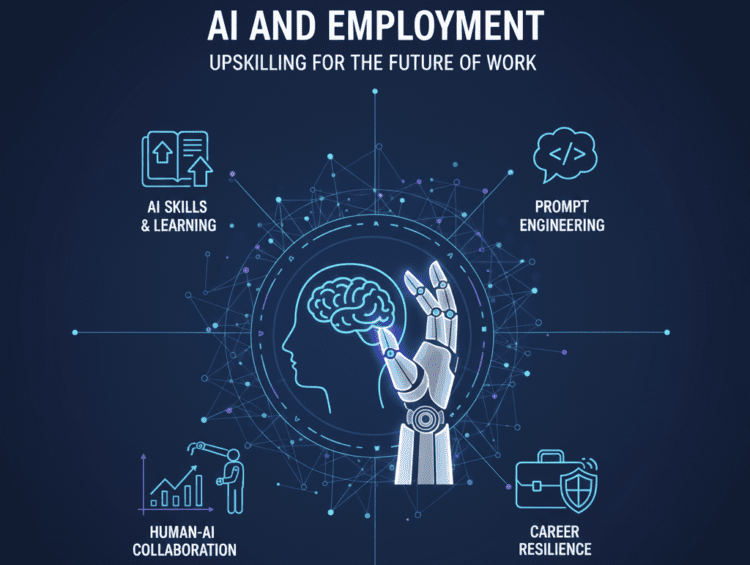
Prompt Engineering Architecture: This transcends merely writing the right words. It involves advanced techniques like understanding the internal logic of LLMs, prompt chaining, and context manipulation to achieve optimal, high-quality outputs.
Instructional Application: Professionals must learn to create robust prompt templates to automate repetitive business tasks (e.g., summarizing reports, drafting communication).
Data Management and Data Wrangling: AI models are only as good as the data they consume. The ability to vet data sets for reliability, integrity, and lack of bias is becoming a core AI skill across all fields. Data governance and ethical sourcing are non-negotiable.
Foundational Machine Learning Concepts: Not everyone needs to build a model, but everyone needs to know how a model works, why it makes certain predictions, and when it might fail (Model Explainability). Understanding the basic principles of statistical inference and probability is crucial for interpreting AI outputs.
Cloud Platform Fluency: Proficiency in deploying and managing AI/ML services on major cloud platforms (AWS SageMaker, Azure ML, Google AI Platform) is essential for moving models from research to production environments.
3.2. Human Competencies AI Cannot Automate (Soft Skills)
These are the uniquely human attributes that differentiate individuals and provide a robust defense against automation:
Systemic and Critical Thinking: While AI generates answers quickly, only humans can assess the impact of those answers on the larger system, evaluate ethical consequences, and determine long-term strategic viability. The capacity to interrogate AI output is now a fundamental business competency.
Emotional Intelligence and Empathy: Relationship building, negotiation, motivational leadership, and understanding complex cultural contexts are roles immune to current automation technologies. These roles will rise in value as technology handles transactional tasks.
Interdisciplinary Agility: The most valuable future employees will be “T-shaped” professionals who combine deep domain expertise (e.g., in Law, Medicine, Marketing) with a broad working knowledge of technical AI skills and tools.
Debugging Mindset: The ability to swiftly identify and resolve not just code errors, but also business process glitches and unexpected outcomes caused by AI decisions, is vital for maintaining operational integrity.
4. Sectoral Transformation Analysis and New Roles
The impact of AI and Employment transformation is highly differentiated across economic sectors:
4.1. Marketing and Content Creation
Former Role Focus: Content Manager focused on repetitive blog posts and basic social media copy.
Emerging Role Focus: AI-Assisted Content Strategist or Prompt Artist. These professionals leverage AI tools to accelerate market research, diversify content ideas, and use the tools as co-creators, focusing on creative vision and brand storytelling. This requires sophisticated AI skills in generative tool mastery.
4.2. Human Resources (HR) and Education
Former Role Focus: HR Specialist managing CV screening and initial candidate interviews.
Emerging Role Focus: AI-Guided Talent Manager. The professional allows AI to handle candidate screening and personnel efficiency analytics, but their critical role shifts to managing ethical use of AI and making high-stakes, bias-free human decisions. In education, the role of the AI-Enabled Personalized Learning Designer will be paramount.
4.3. Finance and Advanced Analysis
Former Role Focus: Financial Analyst performing manual data analysis and spreadsheet maintenance.
Emerging Role Focus: Data-Driven Strategic Consultant. After AI processes vast amounts of market data and generates predictive scenarios, this analyst determines the optimal investment or risk management strategy based on the AI’s complex outputs, requiring strong critical thinking to challenge the machine’s conclusions.
5. Corporate and National AI Adaptation Strategies
This massive transformation requires leadership from both corporations and governments. Successful AI integration involves investing in human capital, not just technology.
5.1. Corporate Restructuring and Training Mandates
Reskilling Over Layoffs: Organizations must commit to reskilling employees whose workloads decrease due to automation, rather than resorting to immediate layoffs. This involves providing comprehensive training and certification programs in in-demand technical AI skills (e.g., Python for data analysis). This strategy retains institutional knowledge and boosts employee loyalty.
AI Governance and Ethics Training: Mandating that every employee receive training on data privacy, bias mitigation, and intellectual property rights related to AI tools ensures a culture of responsible AI use and minimizes legal exposure.
5.2. National Policy and the Role of Education
Governments and educational institutions must fundamentally reshape curricula to prepare the workforce:
Early AI Literacy: Introducing concepts like algorithmic logic, data ethics, and the societal impact of AI at the middle-school level, not just college.
Incentivizing Lifelong Learning: Governments should establish subsidized programs and tax incentives for mid-career professionals to continuously update their AI skills and knowledge, recognizing that continuous learning is the new economic necessity.
6. Conclusion: The Rediscovery of Human Value in AI and Employment
The relationship between AI and Employment can be defined by one word: Augmentation. While automation assumes routine and repetitive tasks, humans will have the opportunity to engage in the highest-value activities—critical inquiry, unparalleled creativity, empathy, and strategic vision.
The job description of the future will be defined not by the code you write, but by how skillfully you manage an AI system, how insightfully you interpret its output, and how effectively you translate that information into human-centric value. The path to success in this evolution lies in embracing continuous learning and viewing AI not as a competitor, but as the ultimate collaboration partner.
The Rise of AI Coding Assistants: How Machines Are Rewriting the Future of Software Development