Table of Contents
The Invisible Giant: Why AI Consumption Matters
Digital Thirst: How Much Water Does a Single Prompt Drink?
Power Hunger: AI vs. Global Electricity Grids
The Hardware Crisis: Rare Minerals and E-Waste
Economic Implications: The Race for “Green” Algorithms
The Double-Edged Sword: Can AI Save the Environment?
Conclusion: Toward a Sustainable Intelligence
1. The Invisible Giant: Why AI Consumption Matters
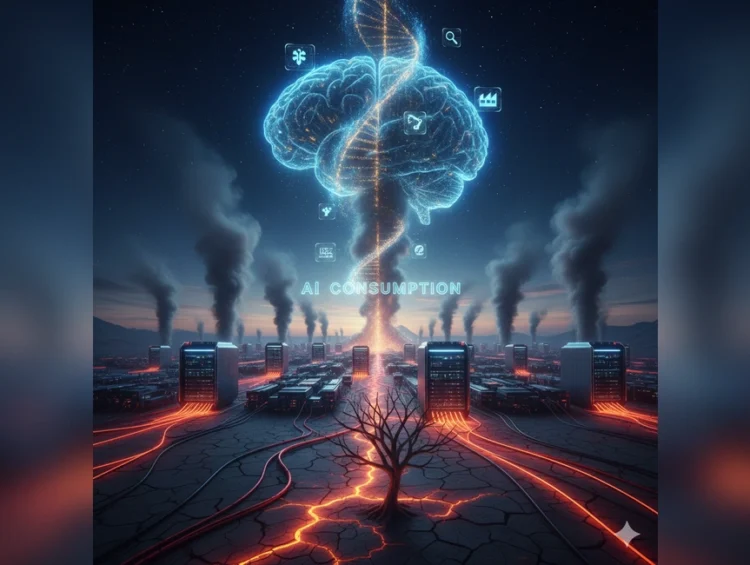
Behind every sophisticated answer from a chatbot and every stunning AI-generated image lies a staggering physical reality. AI consumption is no longer just a technical metric; it is a global environmental phenomenon. While we marvel at the “cloud,” the truth is that AI is grounded in massive, heat-spewing data centers that demand more resources than many small nations. As we move further into 2026, understanding the ecological footprint of our digital assistants is not just for techies—it’s a necessity for every global citizen.
2. Digital Thirst: How Much Water Does a Single Prompt Drink?
One of the most shocking aspects of AI consumption is its “digital thirst.” We often associate computers with electricity, but water is the lifeblood of the data center.
Evaporative Cooling: To prevent thousands of high-end GPUs from melting, data centers use massive cooling towers. This water isn’t just used; it’s evaporated and lost from the local ecosystem.
The 500ml Rule: Research indicates that a simple conversation of 20 to 50 prompts with a Large Language Model (LLM) effectively “drinks” a 500ml bottle of fresh water.
Global Impact: By the end of 2026, it is projected that global AI consumption of water will reach 6.6 billion cubic meters—roughly half the annual water withdrawal of the entire United Kingdom.
3. Power Hunger: AI vs. Global Electricity Grids
If water is the lifeblood, electricity is the oxygen. The scale of AI consumption in terms of energy is reshaping national power grids.
| Task | Estimated Energy Cost | Equivalent |
| 1 Google Search | 0.3 Wh | Minimal |
| 1 AI Text Prompt | 2.9 Wh | 10x Standard Search |
| 1 AI Image Gen | 5-10 Wh | Fully Charging a Smartphone |
| Training GPT-4 | ~50 GWh | Yearly energy of 15,000 households |
This massive surge in demand is forcing tech giants like Microsoft and Amazon to invest in private nuclear fusion and fission projects just to keep the lights on in their server farms.
4. The Hardware Crisis: Rare Minerals and E-Waste
The physical “body” of AI is made of rare earth elements. The surge in AI consumption has triggered a mining gold rush for lithium, cobalt, and copper.
Moreover, the “AI arms race” means hardware becomes obsolete at an unprecedented pace. The H100 and B200 chips of today will likely be electronic waste by 2028. This creates a cycle of extraction and pollution that the planet’s soil can barely sustain. Global e-waste is expected to hit record highs this year, largely driven by the rapid turnover of AI-optimized server components.
5. Economic Implications: The Race for “Green” Algorithms
The global market is reacting. AI consumption is no longer just an environmental issue; it’s a financial one.
Carbon Taxes: Governments in the EU and North America are introducing “Compute Taxes” based on the carbon footprint of data centers.
The Efficiency Premium: Investors are now valuing companies that develop “Thin AI”—models that provide high intelligence with low AI consumption metrics. Efficiency is becoming the new “Gold Standard” in Silicon Valley.
6. The Double-Edged Sword: Can AI Save the Environment?
It is important to note that while AI consumption is high, the technology itself might be the solution. AI is currently being used to:
Optimize Grids: Reducing energy waste in cities by up to 20%.
Design Materials: Finding new battery chemistries that don’t rely on toxic minerals.
Climate Modeling: Predicting extreme weather patterns with 99% accuracy.
The goal is to reach a “Net-Positive” state where the intelligence provided by AI saves more energy and water than the AI itself consumes.
7. Conclusion: Toward a Sustainable Intelligence
As we witness the evolution of the digital age, we must confront the reality of AI consumption. The path forward requires a shift from “Growth at all costs” to “Intelligence with responsibility.” We need transparent reporting on how much water and energy our favorite tools use, and a global commitment to powering the AI revolution with 100% renewable energy.
Intelligence is a beautiful gift, but it shouldn’t cost us the earth.
AI Advancements: 7 Massive Impacts Reshaping the World in 2026